

A whole house fan is not air conditioning and it is not a ceiling fan. It pulls air through the open windows of a house and pushes it out through the attic, replacing the day’s heat in minutes on a cool evening — if the attic can actually vent the air it is being given. Precision Service Electric installs whole house fans in Greeley, and starts by checking the venting and the circuit the unit needs, because those two facts decide whether the fan works or just makes noise. Call 970-593-3190.
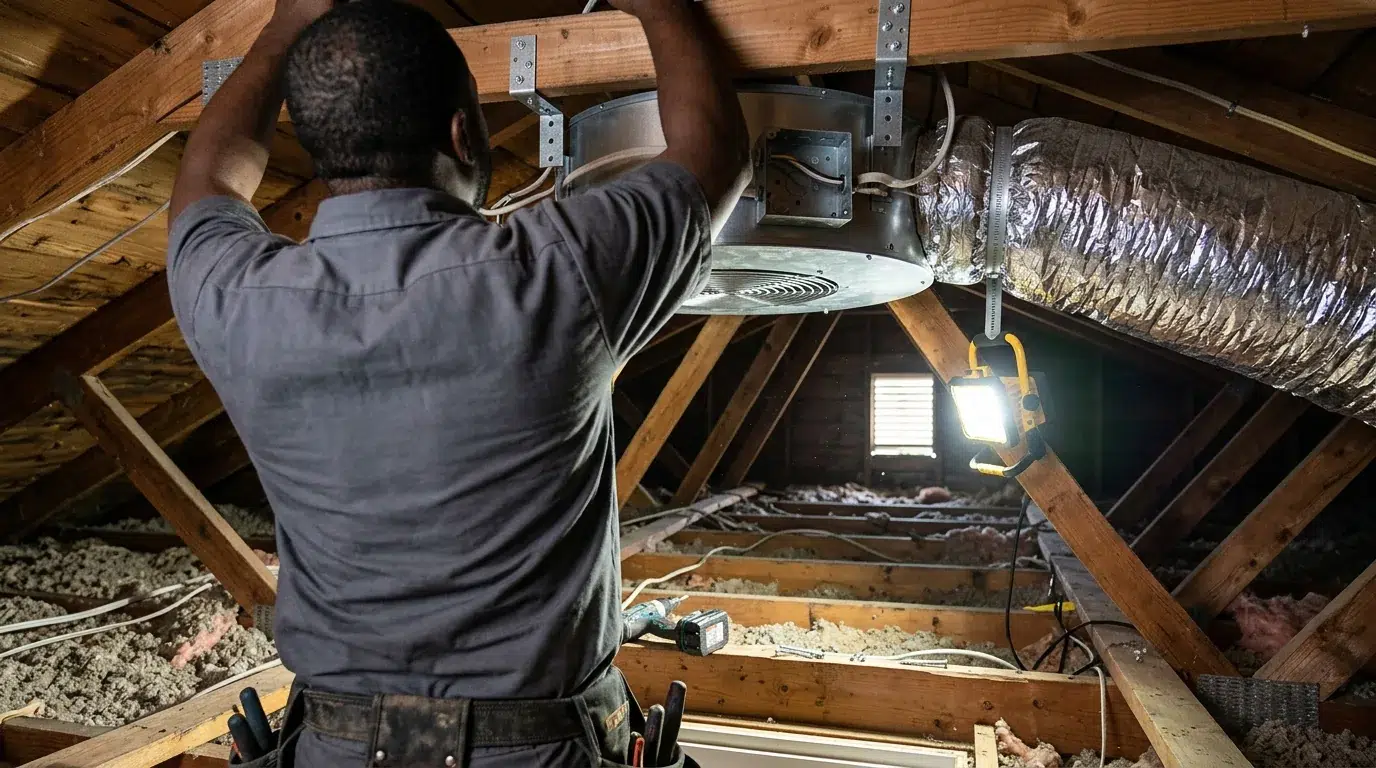
How a Whole House Fan Works
The fan mounts in the ceiling below the attic — usually in a hallway ceiling — with the housing opening into the attic space. Windows on the shaded or cool side of the house are opened a few inches; the fan pulls outside air through them, through the living space, and exhausts the warm air through the attic vents.
The effect is fast: a house that has been closed all day can drop several degrees in ten to fifteen minutes of running. What the fan does not do is cool the air, dry it, or filter it — it moves air. On a hot, still evening with the windows closed there is nothing to move, which is why the honest framing is “cooler evenings, not a replacement for the air conditioner”.
The Attic Has to Be Able to Vent It
Net Free Area, Not Vent Count
Every attic has a venting capacity expressed as net free area — the actual open area of the vents after subtracting their screens and louvers. A rule of thumb used in the trade is one square foot of net free vent area for every 750 CFM the fan moves; the numbers move a little between manufacturers, but the principle does not.
A 3,000 CFM fan therefore needs roughly four square feet of net free area. A typical Greeley attic with two gable vents and a handful of soffit slots may have far less, and a fan installed without checking will pressurise the attic, push air back down through the ceiling, and pull conditioned air out of the house instead of cooling it.
What Fixing Venting Involves
Usually additional soffit or ridge venting, sometimes a larger gable vent. It is roofing-adjacent work, and it is worth knowing before the quote whether it is included — a fan quote that assumes existing venting is adequate is a quote with an unstated condition attached.
The Circuit and the Control
Whole house fans vary: some are cord-and-plug units on a dedicated circuit, some are hardwired, and the motor size ranges from a fraction of a horsepower to a full horsepower or more. Whether the fan needs a new circuit depends on the unit and on what else is on the existing circuit — this is a model-dependent answer, not a universal rule.
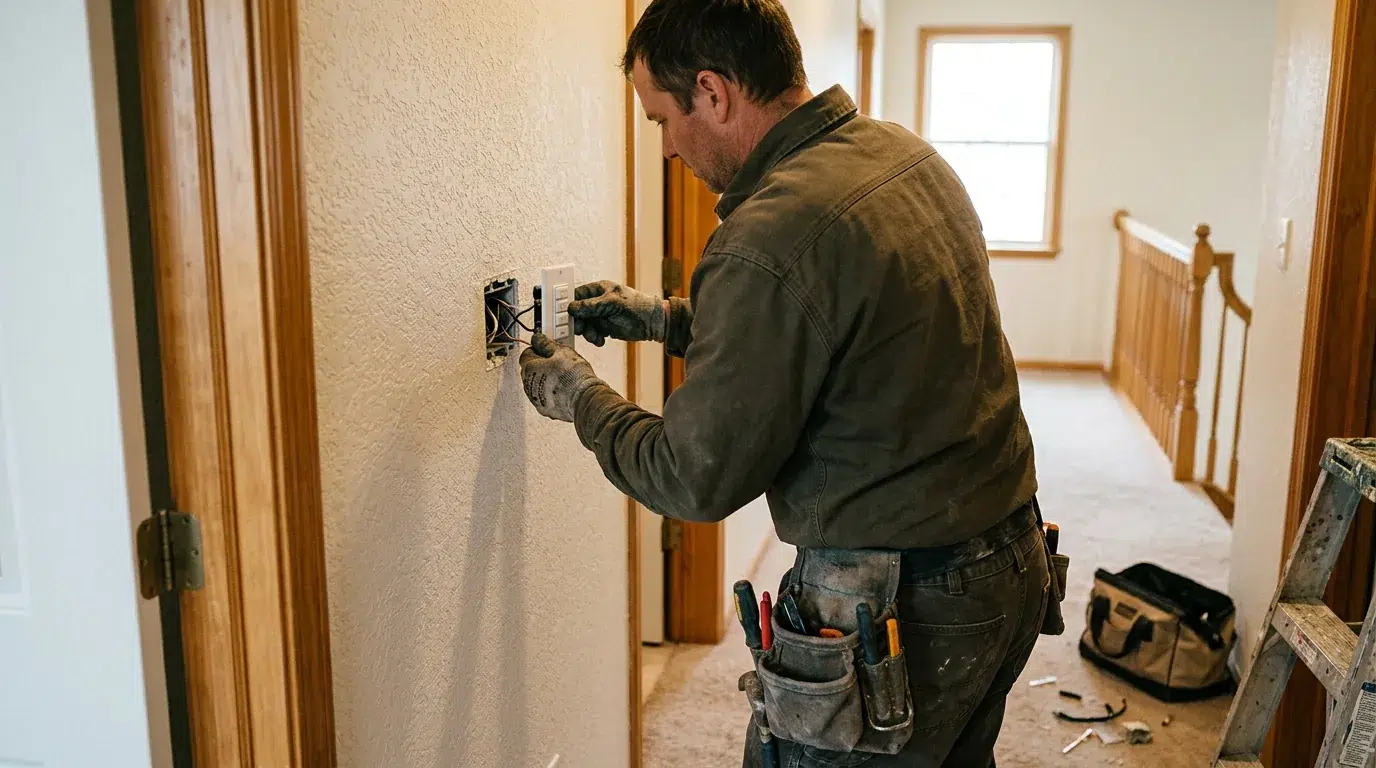
The control matters more than people expect. A simple on/off switch means someone has to remember to turn it off; a timer or a smart control lets the fan run for the twenty minutes that actually cools the house. The control is wired at the same time as the fan, so it belongs in the scope conversation.
Noise, Sizing and the Honest Numbers
Air movement is audible. A fan sized to move a house’s volume of air quickly will be noticeable in the hallway where it mounts, and the quiet units are quiet at the cost of airflow. Sound ratings published by manufacturers are measured in a lab; a hallway ceiling is not a lab.
The other honest number is air changes per hour. Small units move roughly five air changes per hour in a typical house; larger ones run from ten to thirty. A fan quoted as “2 to 3 air changes” is either a very small unit or a mistake.
Permits and Inspection in Greeley
Where a new circuit is added, the work is permitted. The City of Greeley Building Inspection department — 1100 10th Street, Suite 114, 970-350-9830 — takes applications and inspections through the City’s eTRAKiT portal at trakit.greeleygov.com.
The City also publishes that a contractor licence will be required for permits starting January 1, 2027, which is worth knowing if your install is scheduled across the new year.
What a Whole House Fan Costs in Greeley
Published contractor figures are the only ones worth reading, and they are quoted as theirs. Three Crowns Electric lists whole house fan installation at $1,500 to $3,500, with around $2,200 typical. atticfan.com lists roughly $1,495 for a full install, with the unit itself around $900.
What those numbers assume: an accessible attic, an existing circuit that can carry the unit, and attic venting that is already adequate. Any one of those three failing moves the number, and the venting check is the one most often skipped at the quoting stage.
Our Installation Process
Visit and Venting Check
We measure the attic’s existing venting, look at the ceiling location, and check the circuit that would feed the fan.
A Quote That States the Venting
If the attic needs more venting, the quote says so up front rather than discovering it on install day.
Install and Verify
The fan is mounted, wired, controlled and tested — including a check that it is pulling air through the intended windows and exhausting through the attic rather than pressurising it.
Where a Fan Makes Sense — and Where It Does Not
Greeley summers have cool nights, and a house that is closed during the day holds a lot of heat in its structure. That is the profile a whole house fan serves well: run it for twenty minutes in the evening, close up in the morning.
It is a poor fit for a house with no operable windows on a cool side, an attic with no room for additional venting, or a household that needs the house at a fixed temperature through the day. In those cases the honest answer is that the fan is not the right purchase.
Related Work
The same scope is covered for Fort Collins whole house fans and Loveland whole house fans; our service area covers the rest of Northern Colorado.
Frequently Asked Questions
Is a whole house fan the same as an attic fan?
No. A whole house fan moves air through the living space and out through the attic; an attic fan only ventilates the attic itself. They solve different problems and are wired differently.
Do I need a dedicated circuit?
It depends on the unit and on what else is on the circuit. Some fans are cord-and-plug on a dedicated circuit, some are hardwired, and larger motors need their own supply. The answer comes from the unit’s rating, not from a general rule.
How much attic venting does my fan need?
A common rule of thumb is one square foot of net free vent area per 750 CFM. The attic’s existing vents are measured in net free area, not counted, because louvers and screens reduce the actual opening.
Will it cool the house like an air conditioner?
No. It replaces hot indoor air with cooler outdoor air, quickly, when the outside air is cooler. It does not cool or dehumidify the air, so it does not replace an air conditioner on a hot day.
Can it be installed in a two-storey house?
Yes — usually in the upper hallway ceiling, with the attic above. The venting requirement goes up with the volume of air being moved, which is why the attic check comes first.
Do I need a permit in Greeley?
Where a new circuit is added, yes — through the City of Greeley’s eTRAKiT portal, inspected by the City. A swap on an existing dedicated circuit is a different case.


““Professional, reliable, and efficient. Excellent electrical work and great service.””
Request a Whole House Fan Quote in Greeley
Send a photo of the attic space and the hallway ceiling, and we can tell you what the venting will support. Precision Service Electric is family owned, in business 30 years, licensed and insured under Colorado license #3918, and rated 4.8 stars across 47 Google reviews. Call 970-593-3190 or request a quote.