


A whole house fan is the cheapest cooling upgrade a Colorado house can get, and the one most likely to disappoint — because the fan is only half the system. The other half is the attic’s ability to release the air being pushed into it. Precision Service Electric installs whole house fans in Loveland, and checks the attic before quoting a unit. Call 970-593-3190.
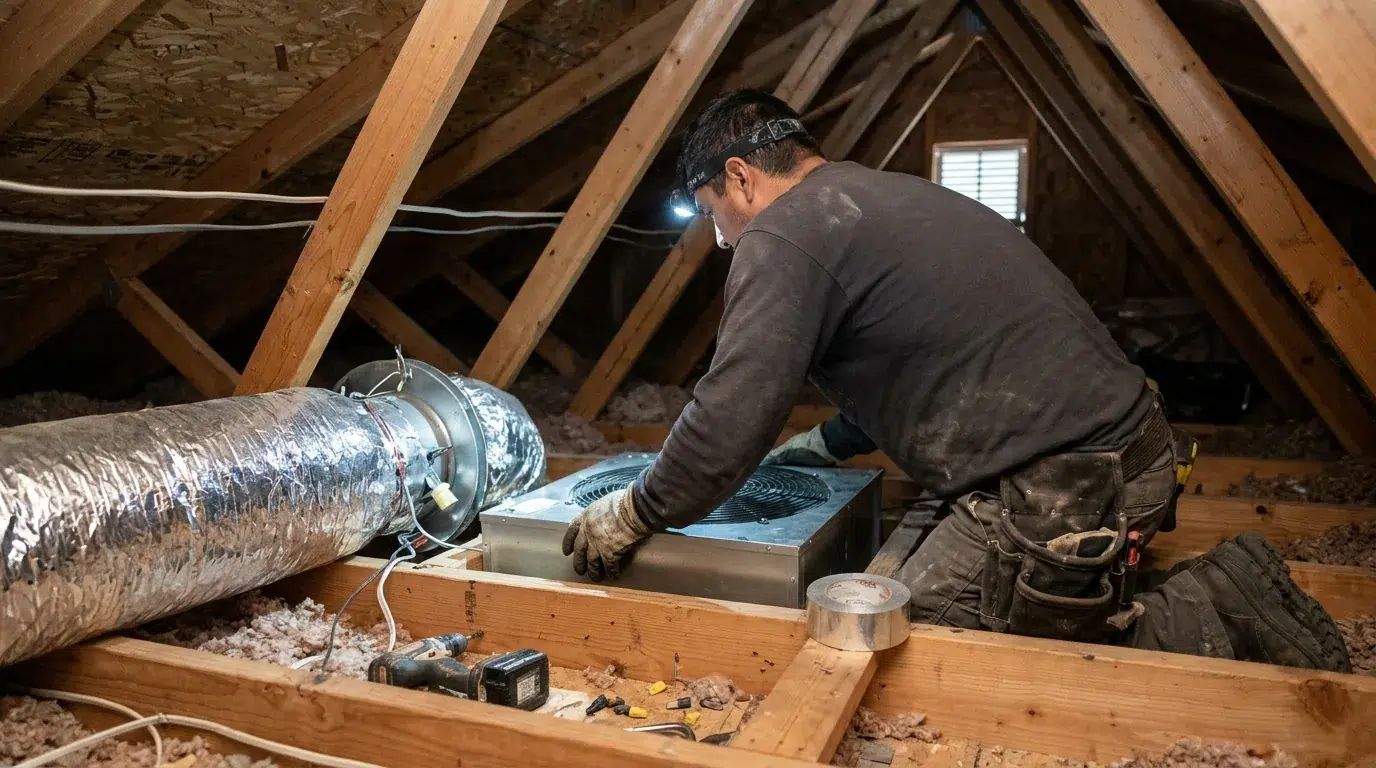
How a Whole House Fan Cools a Loveland Home
The fan sits in the ceiling, usually over a hallway, and exhausts house air into the attic, where it leaves through the attic vents. Open downstairs windows and cooler evening air is drawn through the rooms on its way out. Nothing is refrigerated — the building is flushed with outside air, which is why this works beautifully at nine at night in July and does nothing useful at four in the afternoon.
Loveland’s dry air and large overnight temperature swing are what make the economics work: a fan running for an hour in the evening can replace hours of compressor time. On a smoke-heavy August day it is the last thing you want running.
The rule people get wrong is the windows. Shut them and the fan still moves air — but it pulls it through leaks and other openings instead of through the rooms, depressurising the house and potentially drawing combustion gases indoors. Open enough windows before running the fan, and have combustion appliances and any fireplace evaluated for backdrafting under operating conditions before the fan is commissioned.
Whole House Fan vs Attic Fan vs Air Conditioning
An attic fan works on the attic: it moves air up there and does not deliberately cool a room, though unsealed ceiling penetrations let it draw conditioned air out of the house. A whole house fan is the other kind of machine — it is the rooms, not the roof space, that it empties. Air conditioning is a third thing again: it removes heat from air that is already inside, and the windows make no difference to it.
In Loveland the usual arrangement is both: the fan carries the evening and the shoulder seasons, the compressor handles the afternoons, and the electricity bill reflects which one did most of the work in a given month.
Attic Venting: The Check That Decides Everything
A fan rated at 3,000 CFM moves that volume only if the attic can release it. The preliminary guideline used across the industry is one square foot of net free vent area per 750 CFM of fan rating — and net free area is not the size of the vent opening; each vent has a manufacturer rating, and that rating is what counts.
Take the 750 figure as a starting point and then read the instructions that ship with your unit — they govern, along with whatever the applicable code requires. The failure is always the same shape: soffits buried under insulation, roof or gable vents too small for the airflow, or a ridge vent with nothing feeding it. The attic cannot relieve the air, pressure builds, and it escapes through the weakest joints in the ceiling below.
Loveland’s housing spans mid-century ranches through to new subdivision builds, and the attics are not alike: older roofs often have two gable vents and no soffit path, newer ones a ridge-and-soffit system sized for passive ventilation only. We go up and look, rather than quoting from the age of the house.
The Electrical Side
Whether a dedicated circuit is needed, and what size it has to be, depends on the fan’s electrical rating, its installation instructions, the calculated load and the applicable code. A small direct-drive unit and a larger two-speed unit do not land in the same place.
A disconnecting means within sight is part of the scope where the code asks for one, and the control run for a two-speed or timer setup is wiring, not an accessory. If the panel has no spaces left, the circuit question turns into a panel question before anything is ordered.
Permits in Loveland
Electrical permits come from the City of Loveland Building Division at 410 East 5th Street, 970-962-2505. Counter hours are Monday to Friday 7:30 to 4:00 and the phone line closes at 3:30; records run through the city’s CitizenAccess portal, and inspections are performed by city inspectors rather than a contracted third party.
Loveland Fire Rescue Authority is a separate authority for fire-related scope, which matters when a project touches fire-rated assemblies rather than a simple ceiling opening.
Our Process, Step by Step
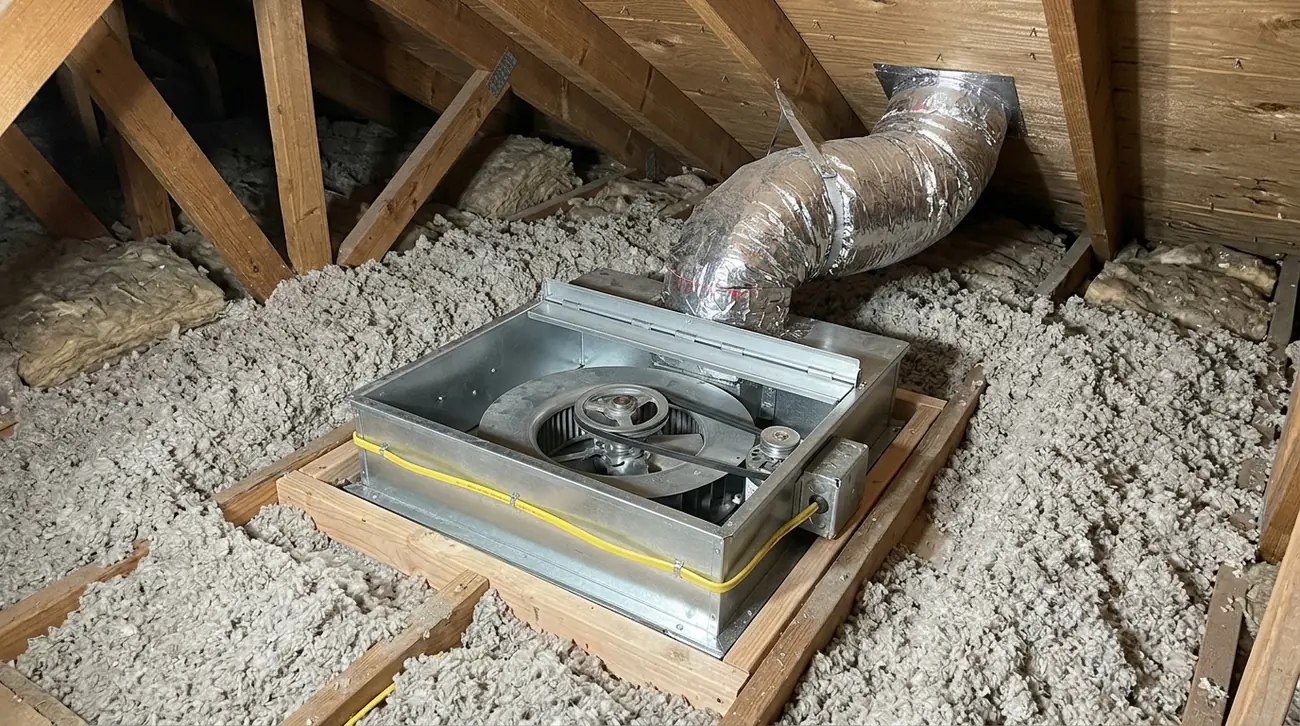
The attic comes first, because it holds the answer: measure the relief area, check the soffit path, and confirm the framing will take the unit where it has to sit. Then the circuit plan, the written scope and the permit; the ceiling opening with its damper and sealing detail; the fan and wiring; a rough inspection if the scope requires one before it is closed up; a run with the windows open; and a final inspection.
Three separate lines on the quote — unit, venting work, electrical — because they are three separate decisions, and the middle one decides whether the other two were worth buying.
Whole House Fan Installation Cost in Loveland
No Loveland-specific survey is published. The nearest attributable figures are Three Crowns Electric’s Northern Colorado numbers: $1,500 to $3,500 installed with a median near $2,200, and a venting-upgrade tier at $2,500 to $3,500. Those are that company’s published figures, not our price list.
Cost swings on: the fan tier and its airflow, whether relief venting has to be added, the circuit and how far it runs from the panel, the control package, and how easy the ceiling is to reach.
Is a Whole House Fan Worth It in Loveland?
Cross-ventilation decides it. Windows on two sides of the house, with a stairwell or hallway between them, give the fan a path; a plan with one window per room gives it nothing to work with. A household that is home in the evening collects the benefit, and one that is out until nine collects much less.
Where it does work, it is the cheapest way to make summer evenings comfortable in a house with decent windows and a vented attic. Where it does not, it is a poor substitute for air conditioning and a waste of money.
Service Area: Loveland and Northern Colorado
Loveland is home base; we also work Berthoud, Johnstown, Windsor, Fort Collins, Longmont, Greeley, Firestone and the surrounding towns, each with its own permitting authority and utility.
Request a Whole House Fan Quote in Loveland
A photo of the attic from the hatch and one of the open panel tells us most of what we need. Precision Service Electric is family owned, in business 30 years, licensed and insured under Colorado license #3918, factory-trained and an authorized Generac dealer, and rated 4.8 stars across 47 Google reviews. Call 970-593-3190 or request a quote.
Related Work in Loveland
The circuit starts at the panel — see panel replacement in Loveland if the spaces are gone. If the ceiling work includes new fixtures, lighting upgrades in Loveland covers layout and dimming. For another town’s version of this job, read the Berthoud fan page or the Windsor page, or start from our service area.

Frequently Asked Questions
Do I need a permit for a whole house fan in Loveland?
A permit is generally required when the installation includes a new electrical circuit, and the City of Loveland Building Division issues it. We confirm the requirements for the specific installation.
Does a whole house fan replace air conditioning?
No. It handles the evening and the shoulder season, and does nothing at four in the afternoon in July. Most Loveland households with a fan run the air conditioning less often — not never.
Why do the windows have to be open?
Because the fan pushes air up and out, it needs somewhere for outside air to come in. Closed windows mean it pulls through gaps and penetrations instead, which depressurises the house.
My attic only has a ridge vent — is that enough?
Often not. The attic needs enough effective vent area for the fan’s air to escape outdoors. A preliminary guideline is one square foot of net free vent area per 750 CFM, subject to the manufacturer’s instructions and the applicable code.
Are there Loveland rebates for a whole house fan?
Loveland Water and Power publishes residential efficiency rebates through Efficiency Works, covering categories such as outdoor LED fixtures and load-sharing devices. We are not aware of a whole house fan rebate and would rather say that than imply one.
How loud is it?
It depends entirely on the unit. A CFM rating says nothing about sound, two models can be ten decibels apart, and an insulated ducted fan sits much quieter than a direct-drive box.