

A whole house fan is a cooling decision and an electrical one: the fan needs a dedicated circuit, a control that makes sense in the hallway, and enough attic venting to actually exhaust the air it moves. Precision Service Electric installs whole house fans in Fort Collins with the electrical work done to code and the venting checked before the fan goes in. Licensed and insured under Colorado license #3918. Call 970-593-3190.
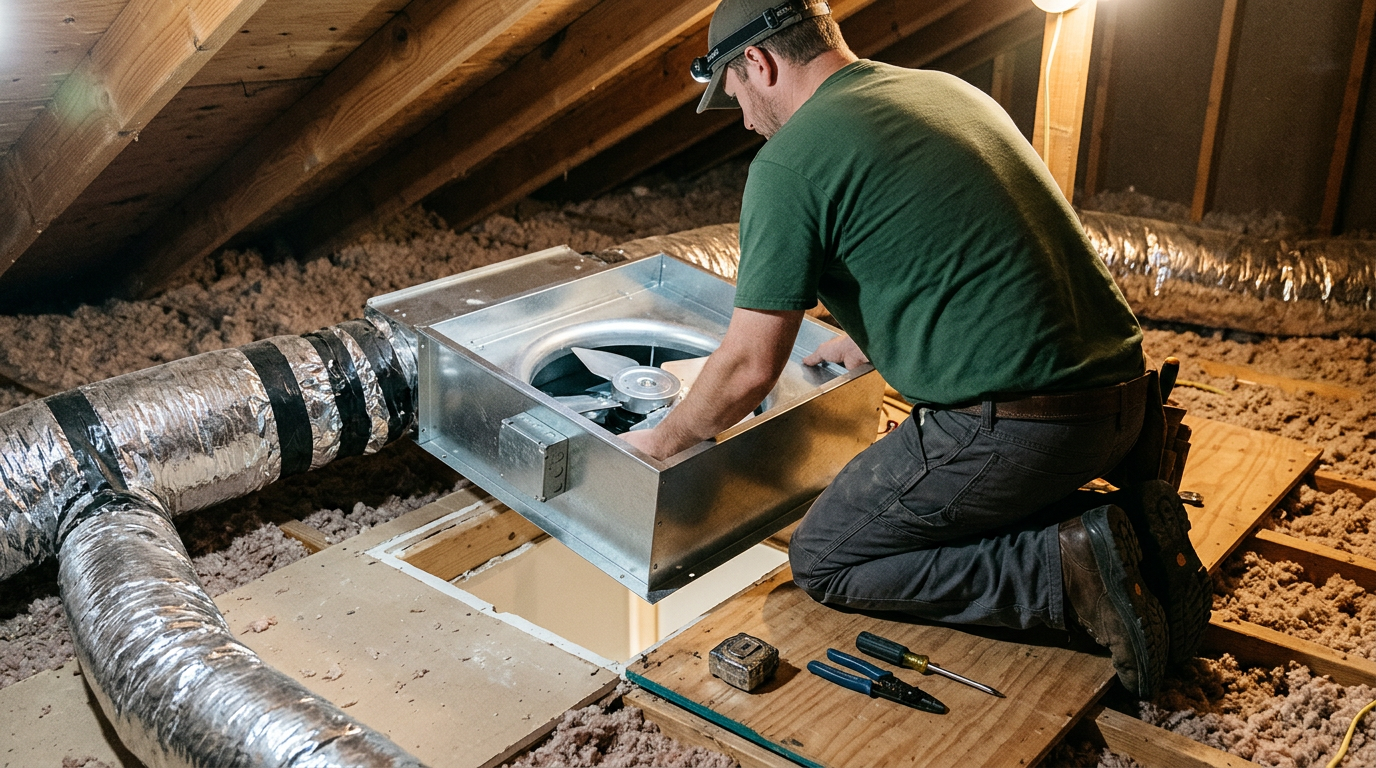
What a Whole House Fan Actually Does
A whole house fan pulls air through the house and pushes it into the attic, where it exits through the roof or gable vents. Open a couple of windows on the cool side of the house in the evening, run the fan, and the hot air that built up during the day leaves in minutes instead of hours. That is the honest version of the promise: it is excellent at replacing hot air with cooler evening air, and it is not an air conditioner — it does not condition anything, and on a 95-degree afternoon with no cool outside air to pull in, it does little.
Which is exactly why it works here. Fort Collins summer evenings drop fast, and a fan that can exchange the air in the house in a few minutes turns that into comfort without running the compressor all night.
Why the Electrical Work Decides Whether It Works
Three electrical details separate a good installation from a noisy, tripping, or ineffective one:
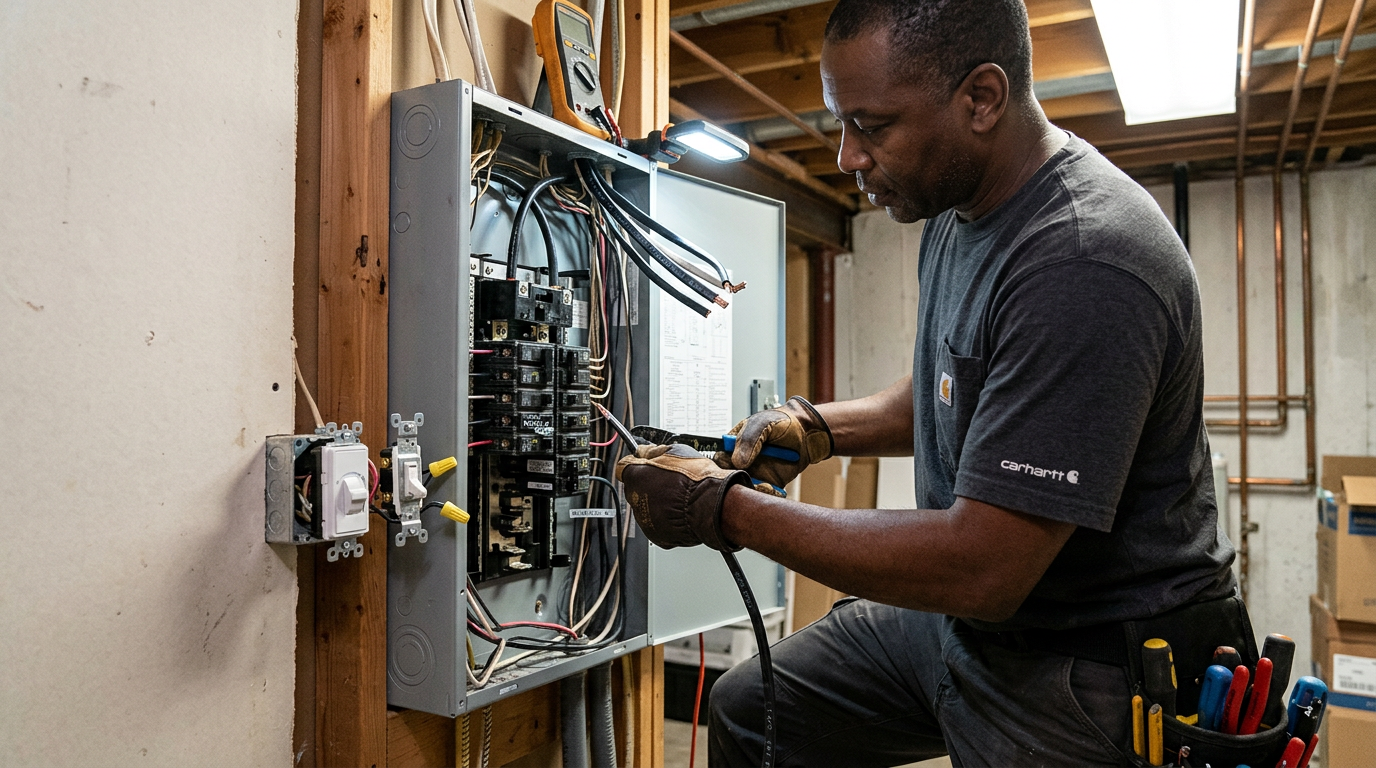
- A dedicated circuit. A whole house fan draws enough that sharing a circuit with receptacles or lighting is a bad idea — and in many panels there is no spare space, which becomes a panel conversation.
- The control location. The fan is usually in a hallway ceiling or a landing; the switch is where you actually walk. Two-speed and timer controls need the right wiring at the box, not after the drywall.
- Safe switching. A fan this size needs a switch rated for the load, and in some installations a disconnect or a service switch at the unit so it can be serviced without hunting for a breaker.
That is our lane: the circuit, the control, the connection, and the inspection. We install the fan model you select — we are not tied to a single brand, and we will tell you what a given unit’s electrical requirements mean for your panel.
Attic Venting: The Part People Skip
A whole house fan can only move as much air as the attic can exhaust. The working rule of thumb is roughly one square foot of net free venting per 750 CFM of fan capacity — a 4,500-CFM fan wants about six square feet of vent area. Many Fort Collins homes, especially older ones, have two or three.
Under-vented, the fan pressurizes the attic, air finds its way out through gaps and can push insulation dust and moisture into the living space, and the fan runs louder and moves less air than its rating. The fix is usually cheap — additional low or ridge venting — but it has to be part of the plan, not an afterthought once the fan is already mounted.
Sizing a Fan for a Fort Collins House
Sizing is a volume calculation, not a guess: square footage times ceiling height, divided by the air changes per hour you want. A typical single-story house lands in the 3,000 to 5,000 CFM range; a two-story with high ceilings goes higher. Oversizing is not free — a fan that exchanges the air too fast can pull conditioned air out of the house in winter if it is used carelessly, and it costs more to buy and to run.
We size to the house and to how you intend to use it, then check that the attic can support that airflow.
What Installation Involves
- Assessment. Attic access, joist layout, venting area, ceiling construction, and the panel’s spare capacity.
- Sizing and placement. Fan capacity, location in the ceiling plane, and the control location.
- Electrical. Dedicated circuit, switch leg, control wiring, and the connection at the unit.
- Mounting and sealing. Fan set into the ceiling with the frame sealed to the drywall, insulation kept clear of the unit, and the attic-side ducting or damper installed as the model requires.
- Test and walkthrough. Airflow checked with windows open, controls explained, and the seasonal-use caveats stated plainly.
Whole House Fan Cost in Fort Collins
Published local pricing frames the market: a Fort Collins electrical contractor’s guide puts a fully installed whole house fan at roughly $1,500 to $3,500, median around $2,200, including permit. Community reporting in the area cites simple installations near $1,495. Those are third-party figures, not our price list.
What moves the number: fan capacity, whether a dedicated circuit has to be added (and whether the panel has room), the venting work required, ceiling height and access, and the control type. A quote given before the attic and the panel are looked at is a guess.
Service Area: Fort Collins and Northern Colorado
We install whole house fans across Fort Collins and the surrounding communities — Loveland, Windsor, Berthoud, Johnstown, Greeley, Longmont and the towns on our service area page. The same work in Loveland is described on our Loveland whole house fan page.
If the electrical plan is bigger than the fan — a basement finish, added lighting, or an EV charger — the panel conversation is covered on our Fort Collins panel replacement page, the broader electrical scope of a remodel on our basement electrical page, and lighting work on our lighting upgrades page.
Request a Whole House Fan Quote in Fort Collins
Call 970-593-3190 or send us a message. Tell us the square footage, whether the attic is accessible, and whether you already have a fan picked out; we will check the venting and the panel and quote the installation.
Precision Service Electric — 1320 8th St SE, Loveland, CO 80537. Licensed and insured under Colorado license #3918. Family-owned, in business 30 years, rated 4.8 stars across 47 Google reviews. Office hours Monday through Friday, 7:00 AM to 4:00 PM.


“I called Precision Service Electric to discuss a ceiling fan problem with the remote and housing unit. Bill, the electrician came out the following morning and was able to troubleshoot the issue and fix it in a short amount of time. I found Bill to be friendly and explained everything he'd done to fix the problem. The price was very reasonable and I will use this company in the future.”
Frequently Asked Questions
Does a whole house fan need a dedicated circuit?
In practice, yes. A whole house fan draws enough current that sharing a general-purpose circuit invites nuisance tripping and is poor practice. The installation also needs a properly rated switch and, in some configurations, a service switch at the unit. If the panel has no spare space, adding the circuit becomes part of the project.
How much attic venting does a whole house fan need?
The rule of thumb is about one square foot of net free venting per 750 CFM of fan capacity — so a 4,500-CFM fan wants roughly six square feet. Many older Fort Collins attics have considerably less, which is why we check venting before recommending a fan size rather than after.
Will a whole house fan replace my air conditioning?
No. It replaces hot indoor air with cooler outdoor air, which handles evenings and shoulder seasons well. On hot afternoons with no cool air outside, it cannot do what an air conditioner does. Most homes use both, with the fan carrying the load when the outside temperature drops.
Can a whole house fan be installed in a two-story house?
Yes, with a different plan. Two-story homes usually want the fan in a central hallway ceiling on the upper floor with windows open on the lower floor, so air moves through the whole house rather than one level. Ceiling height and joist layout determine what fits.
How loud is a whole house fan?
It is audible — it is moving a house worth of air. Two-speed units let you run it low for background exchange and high for a fast cool-down. Mounting quality matters as much as the unit: a fan set into a sealed frame with the insulation kept clear is noticeably quieter than one that vibrates against drywall.
Do I need a permit for a whole house fan in Fort Collins?
The electrical circuit is permitted work, and it is inspected with the installation. The permitting path follows the City of Fort Collins Building Services electrical scope for the circuit being added. We confirm what the specific installation requires and include it in the proposal.