

Longmont is one of the few Colorado cities that buys and sells its own electricity, and that changes the EV charger conversation twice: the rebate is the city’s rather than Xcel’s, and the rates the charger will run on are the city’s tiered schedule rather than a statewide one. Neither fact appears on the pages currently ranking for this search. Precision Service Electric installs Level 2 chargers in Longmont, sizes the circuit from the load calculation, and gets the utility side right before the equipment is ordered. Call 970-593-3190.
What the Search Results Get Wrong
Search for EV charger installation in Longmont and the results are dominated by public charging: a 350 kW Electrify America cabinet on Main Street, the Tesla Supercharger at Ken Pratt Boulevard, a 7 kW ChargePoint post on Terry Street, and a fuel station listed on PlugShare at roughly 45 cents a kilowatt hour — that listing’s rate, not a utility tariff. Those are real, useful, and not what a household is buying.
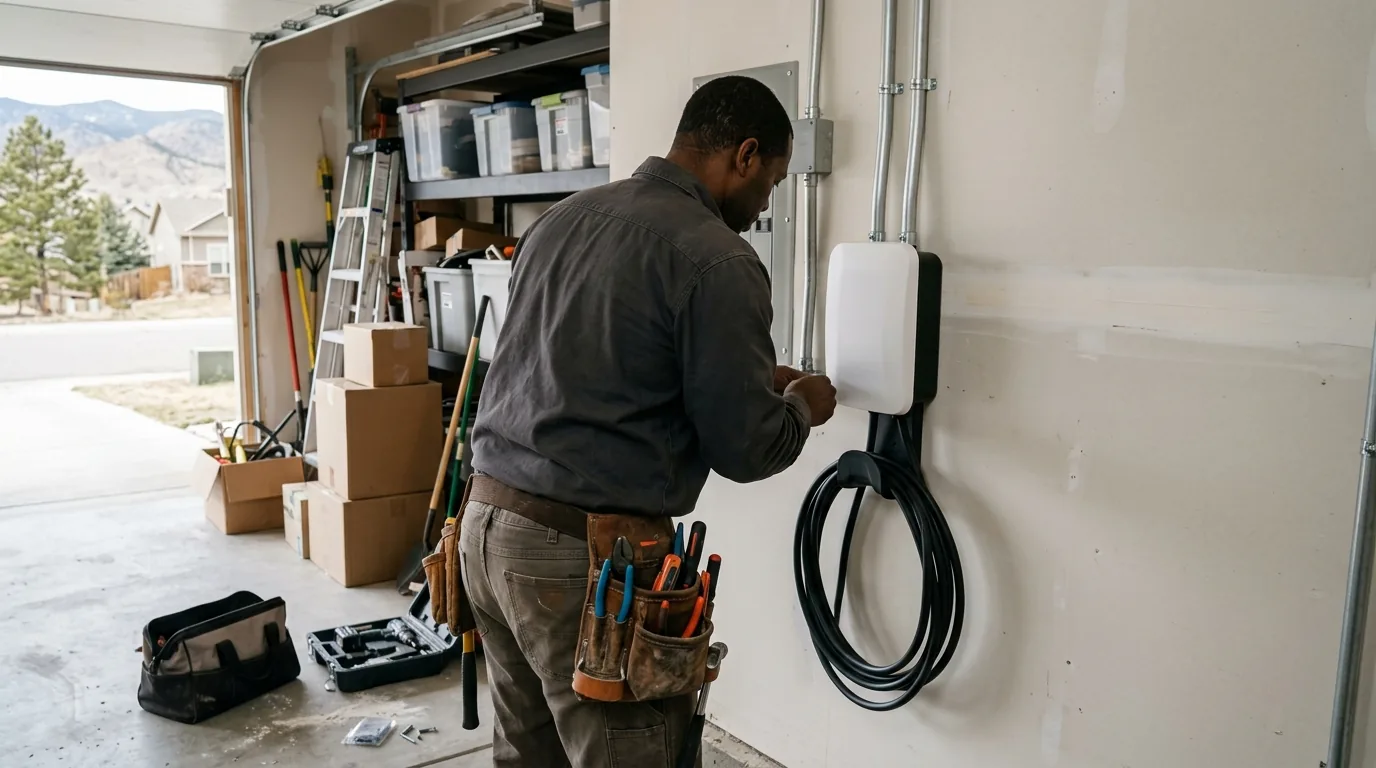
Home charging is a dedicated 240-volt circuit on your property, protected by its own breaker, inspected by the City, and sized to the car and the panel. The difference between that and a public fast charger is not the plug — it is who owns the circuit and who pays for the electricity.
Level 1, Level 2 and What a Household Actually Needs
What 120 Volts Covers
A standard outlet returns roughly three to five miles of range per hour. For a plug-in hybrid, or a driver doing under about thirty miles a day who can leave the car plugged in overnight, that is genuinely enough — and worth saying before anyone sells a circuit.
What 240 Volts Changes
A Level 2 circuit delivers 25 to 40 miles of range per hour, which is what makes a full battery workable on an ordinary commute. The car’s onboard charger is the ceiling: a 60-amp circuit does nothing for a vehicle that accepts 32 amps.
Why Public Fast Chargers Are a Different Product
High-power public DC fast charging is commercial equipment, typically on a three-phase service; lower-power DC units do exist on single-phase supplies, but none of it is a residential installation.
The Circuit, and the Panel Behind It
Most home chargers land on a 40- or 50-amp circuit, delivering about 32 to 40 amps of continuous charging; some hardwired units use 60 amps for 48 amps of charging. Continuous loads run at no more than 80 percent of the circuit rating, so the arithmetic is fixed by code rather than by preference.
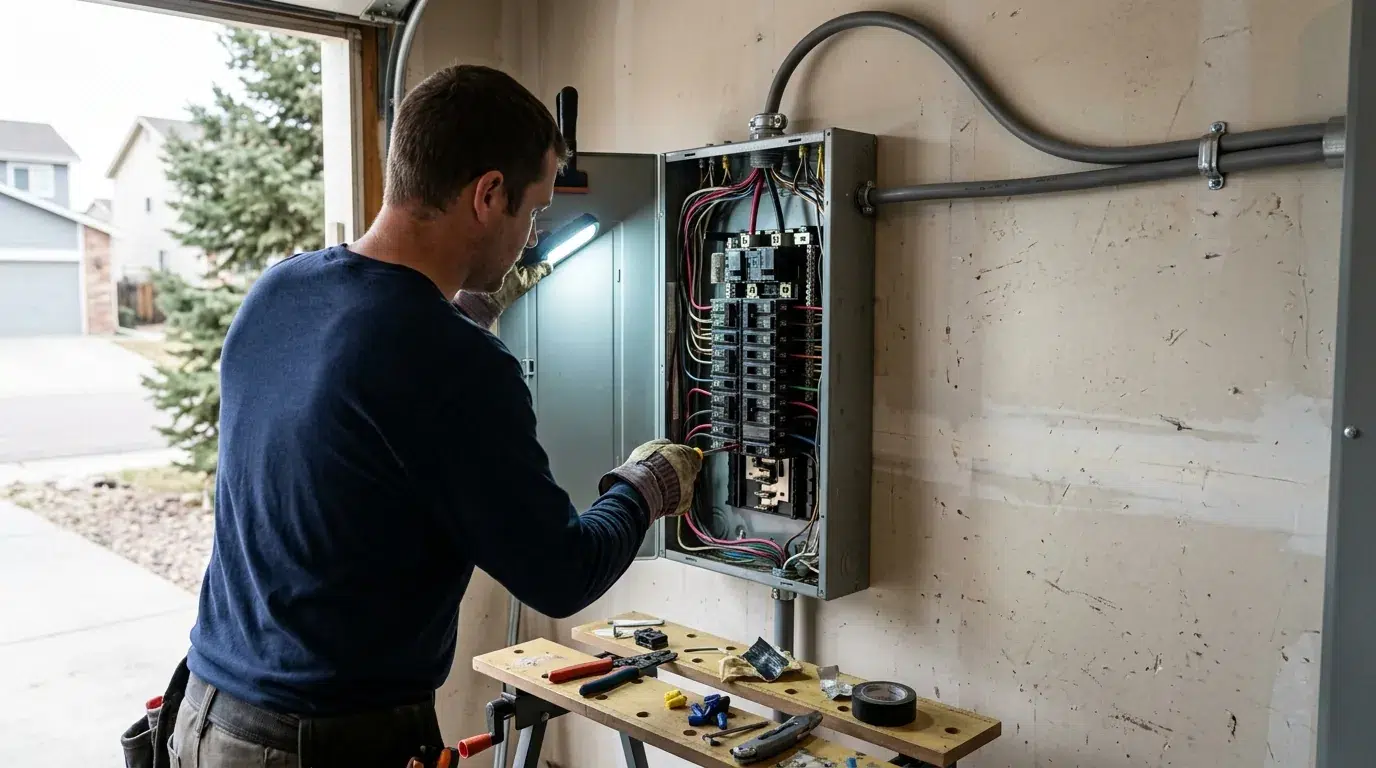
Before any of that, the existing load is calculated — square footage, heating and cooling, range, dryer, water heater, and the large circuits already present. Longmont’s older houses near downtown often heat with gas and have room on a 100-amp service; a 1990s subdivision house with electric everything may not. The calculation is the difference between a quote and a guess.
Hardwired or Receptacle
A hardwired charger connects permanently to the circuit and can use its full rating. A NEMA 14-50 receptacle keeps the unit movable and swappable without an electrician. Both are inspected; the choice is about whether the equipment stays put.
An EV charging receptacle needs ground-fault protection; a hardwired unit relies on the personnel protection built into the equipment, plus whatever the location and circuit require. Outdoor-mounted equipment has to be rated for outdoor use. That is design work, not an accessory decision.
Longmont Power & Communications: Rebate and Rates
LPC is the municipal utility — public power since 1912, with its main office at 1100 S Sherman Street and outage reporting on 303-651-8386 or 303-776-0011. Natural gas in Longmont comes from Xcel Energy, which matters only when a house is switching appliances between fuels.
LPC publishes a residential rebate for a new Level 2 vehicle charger, up to $500 for a single residential unit, with the current application round closing November 1, 2026. Programme terms, eligibility and any successor round live on the utility’s own page — read them before counting on a figure, because a rebate that closed is not a rebate.
The rate structure matters more over the life of the car. LPC’s residential energy rate is tiered: up to 750 kWh, then 751 to 1,500, then everything above, at 10.57¢ / 12.45¢ / 16.18¢ per kWh in non-summer months and 11.64¢ / 13.73¢ / 17.83¢ in summer, with a $17.50 monthly customer charge. An EV typically pushes a household into the third tier, which is why the charging window and the annual mileage matter as much as the circuit.
LPC also offers an optional residential demand rate. Whether it beats the standard tiers depends on the household’s load shape, and it is worth modelling before switching rather than after.
Permits and Licensing in Longmont
A new 240-volt circuit is permitted work. City of Longmont Building Services issues the permit at the Development Services Center, 385 Kimbark Street — 303-651-8332 — and applications and inspections run through the Accela Citizen Access portal. Inspection requests must be in by 4:00 p.m. the business day before.
The licensing requirement is worth checking on any quote: the City requires a Longmont contractor licence under Municipal Code 16.48.030, offers no reciprocity with other jurisdictions, and requires electricians to hold a current Colorado master licence and contractor licence. A Denver or Boulder licence does not carry.
What the Installation Involves
The site visit establishes where the car parks, what the panel can carry, and how the cable reaches the spot — through a garage wall, across a ceiling, or out to a detached garage. Then the written quote states the circuit rating, hardwired or receptacle, the route, any panel work, and the permit.
Install day is the breaker, the conductors, the equipment, testing, and the inspection. Most garage installs are a half day; a detached garage or a long conduit run makes it longer.
What Drives the Cost
Distance from the panel is the biggest variable, followed by what the route crosses, whether the panel has capacity, hardwired versus receptacle, and indoor versus outdoor placement. The charger itself is usually the smallest line on the quote.
Any figure offered before the panel has been looked at is provisional. If a quote seems unusually low, ask what the permit line says and what circuit work is included.
Related Work in Longmont
If the load calculation says the panel is the constraint, the answer is on the electrical panel replacement in Longmont page. The same charger work elsewhere is covered for Fort Collins and Windsor; our service area covers the rest of Northern Colorado. The same charger work in Loveland is on the Loveland EV charger page, and if the panel is the constraint, panel replacement in Loveland covers it.
Frequently Asked Questions
Does Longmont have a rebate for EV chargers?
Yes — LPC publishes a residential rebate of up to $500 for a new Level 2 charger, with the current round closing on November 1, 2026. Eligibility and terms are on the utility’s own page, and they change between rounds.
Will my panel carry a Level 2 charger?
Often yes, especially in a gas-heated house. It depends on the full load calculation rather than on the service size alone — a house with electric heat and an electric dryer is a different answer.
Do I need a permit in Longmont?
Yes. A new 240-volt circuit is permitted work through City of Longmont Building Services and is inspected by the City.
How long does the install take?
A straightforward garage install close to the panel is a half day. Longer runs, finished walls or a detached garage can make it a full day or more; the quote states the window.
Can I use a Tesla Wall Connector or another brand?
The circuit work is the same whichever connector goes on the end of it. What changes is the equipment’s rating and whether it is hardwired — both settled before the circuit is sized.
Is the LPC demand rate worth switching to?
Only if the household’s load shape suits it. It is an optional rate, not a default, and the comparison depends on when the big loads run — worth modelling with real usage rather than assumed.


“They have great service and are very professional! We will definitely call again with any future needs.”
Request an EV Charger Quote in Longmont
Send a photo of the panel and where the car parks, and we can tell you which circuit your house supports before anyone visits. Precision Service Electric is family owned, in business 30 years, licensed and insured under Colorado license #3918, and rated 4.8 stars across 47 Google reviews. Call 970-593-3190 or request a quote.