


A home EV charger is a 240-volt circuit job before it is a hardware purchase: the breaker, the wire run from your panel, a Town of Windsor permit, and a SAFEbuilt inspection all have to line up. Precision Service Electric installs Level 2 chargers in Windsor and calculates the existing load before sizing the circuit, so you know whether your panel can carry the charger before anyone quotes. Call 970-593-3190.
Home Charging in Windsor, Explained
Overnight charging at a useful rate usually needs more than the cord in the box: a dedicated 240-volt circuit, installed by a licensed electrician, protected by its own breaker, and inspected. Run a correctly sized circuit to where the car parks, connect the charger, pass inspection. Distance from the panel, finished walls, spare capacity, and hardwired versus outlet all change the scope and price.
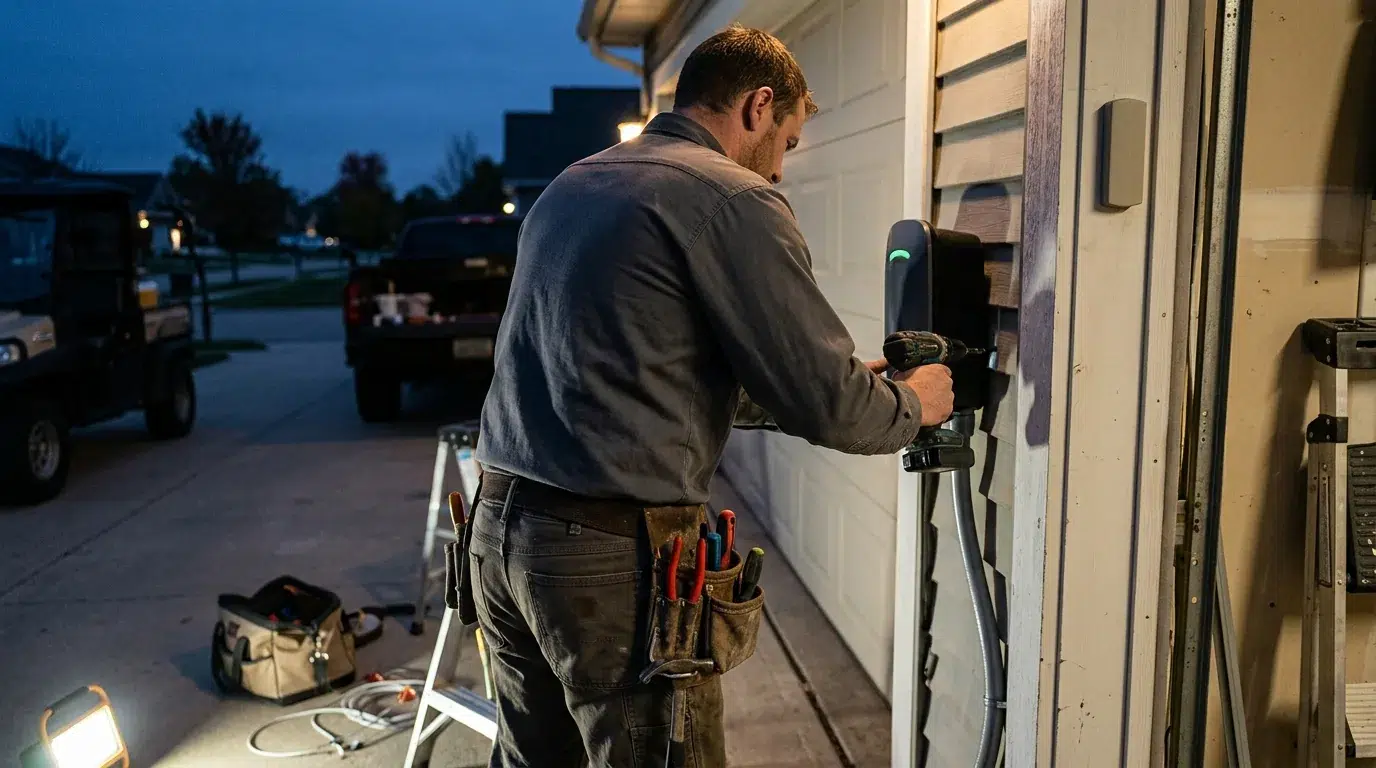
Level 1 vs Level 2: What Actually Matters
What Level 1 Can and Cannot Do
Level 1 uses a standard 120-volt outlet and adds roughly three to five miles of range per hour. For a plug-in hybrid or a driver covering under about 30 miles a day, overnight Level 1 can cover the daily need. Recharging a large battery from low is slow — a full charge can take well over a day.
What a Level 2 Circuit Adds
Level 2 runs on 240 volts and typically adds 25 to 40 miles of range per hour. That is the difference between topping up nightly and planning the week around charging. For most households with a full EV and a normal commute, Level 2 is the practical choice.
DC Fast Charging Is Not a Home Option
DC fast charging is public-station equipment that needs commercial-grade power homes do not provide. Home charging is Level 1 or Level 2; DC fast charging is for road trips.
Power, Panels, and Circuit Size
How Much Power Your Charger Needs
Home Level 2 chargers typically use a 40- or 50-amp circuit, supporting about 32 to 40 amps of continuous charging; some hardwired units use 60 amps for up to 48 amps of charging. Continuous loads may run at no more than 80 percent of the circuit rating, so a 50-amp circuit supports a 40-amp charge rate. The circuit is sized to the vehicle and the panel.
The Load Calculation Comes First
Before a charger circuit is sized, the existing load is calculated: square footage, major appliances, heating and cooling, range, dryer, water heater, and existing large circuits. The charger is added to that picture — the step that separates an honest answer from a sales pitch.
If Your Home Has 100-Amp Service
A 100-amp service can often carry an EV charger, particularly with gas heat, a gas range, and no hot tub. Electric heat or a heat pump plus electric appliances may leave no room for a 40-amp continuous load; the numbers decide.
Panels With No Spare Capacity
A 200-amp panel usually has room, but “usually” still needs the calculation; some older panels have space for a breaker and no capacity to spare. If the service cannot carry the load: a panel or service upgrade, a lower-amperage charger, or load management where code allows.
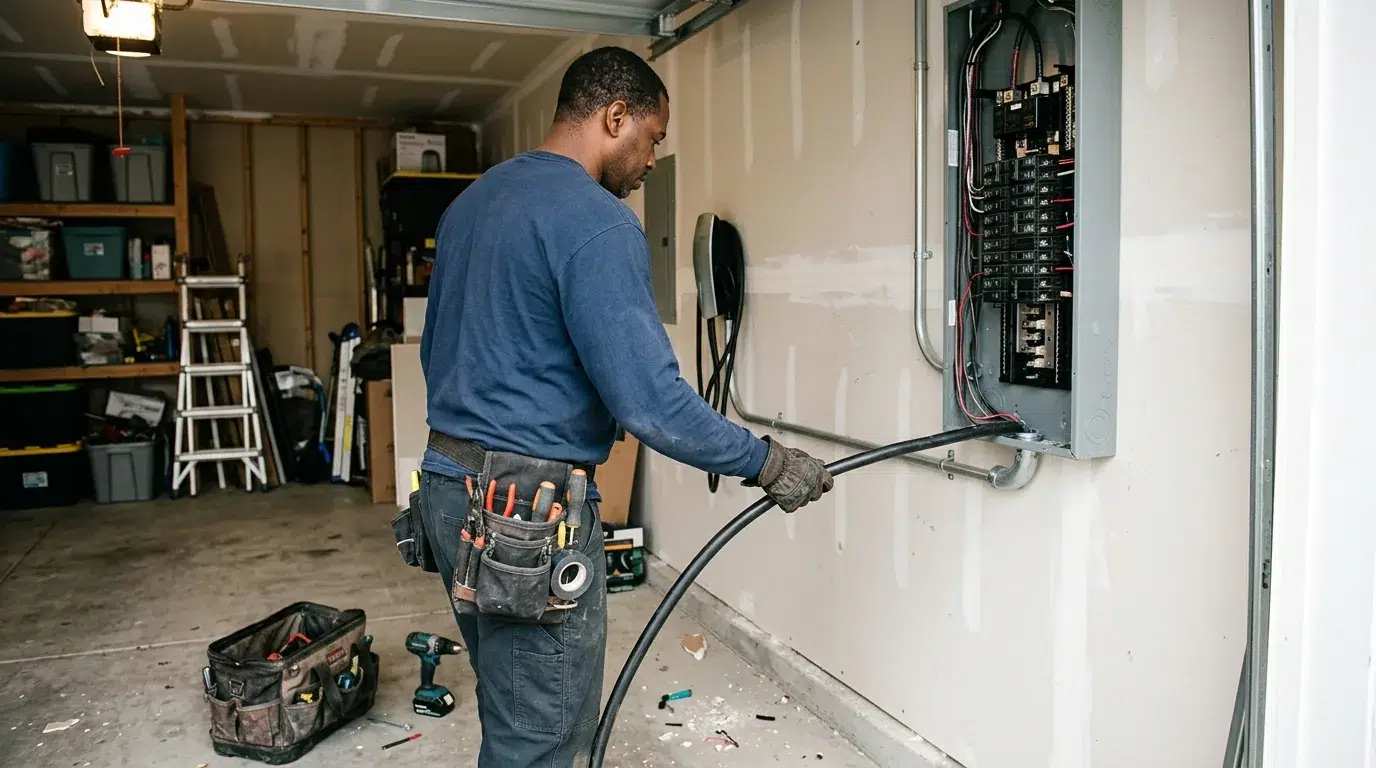
Hardwired Charger or a 14-50 Outlet?
A hardwired charger connects directly to the circuit: cleaner, up to 48 amps on many units, and free of the GFCI breaker a 240-volt outlet requires, which some chargers nuisance-trip. A NEMA 14-50 outlet lets you unplug, move, or replace the charger without an electrician. Both are code-compliant; the choice depends on your plans and your vehicle.
Xcel’s Charger and Wiring Rebate in 2026
Windsor sits in Xcel Energy’s electric territory, and Xcel offers a Charger and Wiring Rebate for eligible residential customers. It applies to an eligible Level 2 charger and/or the 240-volt circuit wiring, which must be installed by a licensed electrician. Amounts and eligibility are published on the program page and may change — check there rather than relying on an older blog post.
The rebate requires enrollment in a qualifying Xcel charging program — currently Optimize Your Charge — before applying. Xcel’s EV Accelerate At Home program closed to new Colorado applications on July 14, 2026; existing participants may still apply for the rebate, but new applicants can no longer enroll in that pathway. Applications go through My Account; Xcel’s EV team answers questions at EV*******@********gy.com or 800-895-4999. Eligibility depends on the customer, the equipment, and enrollment — Xcel decides, not the installer.
Smart Charging and Off-Peak Hours
Compatible chargers and vehicles may support scheduled charging and a configurable charge limit. Whether an off-peak window saves money depends entirely on the rate plan on your account — check your plan and Xcel’s program pages before counting on a savings figure.
Permits and Inspections in Windsor
An EV charger circuit is permitted electrical work in Windsor. The Town requires no contractor license of its own, but electrical contractors must hold a current State of Colorado electrical license, with the company and master electrician’s licenses submitted to the Town. Precision Service Electric is licensed and insured.
Inspections run through SAFEbuilt at 970-674-1036. The Town adopted the 2024 I-Codes effective January 1, 2026, so this year’s work is inspected against current code. The permit and the passed inspection document the required approval of the installation.
What the Installation Involves
The work starts with what you drive, where it parks, your daily miles, and whether a second EV is coming. Then the panel is inspected, the load calculated, and the circuit path identified — through a garage wall, across a ceiling, or to a detached structure. The installation sets the breaker, runs and protects the conductors, connects the equipment, tests the circuit, coordinates the inspection, and walks you through charging.
What EV Charger Installation Costs in Windsor
Published local pricing frames the market. Three Crowns Electric lists $800 to $2,500 on its Windsor EV page for installation labor and materials, excluding the charger; MSI Mechanical lists $400 to $1,200 for charger hardware. Those are their published numbers, not a Precision Service Electric quote.
What moves the price: run length and difficulty, finished walls, panel capacity, hardwired versus outlet, and an exposed versus indoor location. A quote given before the panel is checked is a guess with a signature line.
Public Charging vs Charging at Home
Public charging covers two different things: public Level 2 stations (the 7 kW and 10 kW J1772 chargers at municipal and shopping locations) for errands and long stays, and DC fast charging for a quick stop on a road trip. Home charging happens while you sleep, at residential rates, at the charge level you set. Which fits depends on daily miles and where the car parks.
Serving Windsor and Northern Colorado
We install EV chargers throughout Windsor — Water Valley, Pelican Lakes, RainDance, Highpointe, and the 80550 ZIP code — and across the surrounding communities we serve from our Loveland shop: Fort Collins, Loveland, Berthoud, Johnstown, Greeley, Longmont, Firestone, Timnath, Severance, and Eaton. The full list is on our Northern Colorado service area page.
We also handle electrical panel replacement when a charger circuit calls for it, and as an authorized Generac dealer we install and service Generac generator service.
Request an EV Charger Quote in Windsor
Tell us what you drive, where it parks, and when you are home. We will check the panel, confirm the circuit size, and give you an upfront estimate. Call 970-593-3190 or contact Precision Service Electric. Office hours: Monday through Friday, 7:00 AM to 4:00 PM.
Precision Service Electric is family owned, in business 30 years, licensed and insured under Colorado license #3918, with a 4.8-star Google rating across 47 reviews. See also EV charger installation in Loveland, or start from the Precision Service Electric homepage.
Frequently Asked Questions
Do I need a permit to install an EV charger in Windsor?
Yes. A new 240-volt charger circuit is permitted electrical work in Windsor, and the Town requires the electrical contractor to hold a current State of Colorado electrical license, with the company and master licenses submitted. Inspections are scheduled through SAFEbuilt at 970-674-1036, and the Town inspects against the 2024 I-Codes, effective January 1, 2026. The permit and passed inspection document the approval — the record a future buyer’s inspector looks for.
What does EV charger installation cost in Windsor?
Two local companies publish their own figures: Three Crowns Electric lists $800 to $2,500 for installation labor and materials on its Windsor EV page, excluding the charger, and MSI Mechanical lists $400 to $1,200 for charger hardware. Those are their numbers, not a Precision Service Electric quote. Your cost depends on the length and difficulty of the circuit run, whether walls are finished, whether the panel has capacity, hardwired versus outlet, and whether the charger sits indoors or outside. The estimate follows the load calculation.
Is the Xcel EV charger rebate still available?
Xcel’s Charger and Wiring Rebate remains available for eligible residential customers, but the rules changed in 2026. Enrollment in a qualifying program — currently Optimize Your Charge — is required before applying, and EV Accelerate At Home closed to new Colorado applications on July 14, 2026, though existing participants may still apply for the rebate. Applications are submitted through My Account. Current amounts and eligibility live on Xcel’s program page; the EV team answers questions at EV*******@********gy.com or 800-895-4999. Xcel decides eligibility, not the installer.
Will my 100-amp panel support an EV charger?
It can, depending on the rest of the load. A 100-amp service with gas heat, a gas range, and no hot tub often has room for a 40-amp charger circuit. A home with electric heat or a heat pump plus electric appliances may have no capacity left for a continuous 40-amp load. The answer comes from the load calculation: square footage, major appliances, heating and cooling, and existing large circuits, with the charger added. A panel upgrade is right only when that math requires it.
Should I hardwire the charger or use a 14-50 outlet?
Hardwiring is cleaner and supports higher amperage — up to 48 amps on many units — and it avoids the GFCI breaker that a 240-volt outlet requires, which some chargers nuisance-trip. A NEMA 14-50 outlet is more flexible: you can unplug the charger, move it, or replace it without calling an electrician. Both arrangements are code-compliant and both get inspected. Choose the outlet if you may move or change equipment; choose hardwiring if you want maximum charging speed and a permanent installation.
Which chargers do you install?
Precision Service Electric installs Level 2 home charging equipment as part of the circuit installation. The correct charger depends on your vehicle’s onboard charging limit and the circuit the panel can support. The electrical side is the important part: the charger’s amperage requirement has to match the circuit, and the circuit has to match the panel’s capacity. Bring the charger you are considering to the conversation and its specification gets checked against the installation.
How long does the installation take?
It depends on the scope, and a fixed duration quoted before seeing the panel is a guess. A short run in an open garage differs from a long exterior run, a finished-wall path, or a job that needs a panel upgrade. The variables: distance to the charger, how the wire must travel, whether the panel has spare capacity, and when the inspection can be scheduled. The scope is confirmed after the panel is inspected and the load calculated.
Can the charger go outdoors or on a detached garage?
Yes, with equipment rated for the location and a compliant circuit path. Outdoor installations use weather-appropriate equipment and mounting, and the circuit has to be protected for the conditions it passes through. On a detached garage the routing depends on the site, the existing supply, and what the code requires for that structure — it may be underground or overhead. Either way the installation is inspected like any other circuit.
Do you install chargers in my Windsor neighborhood?
We install EV chargers throughout Windsor, including Water Valley, Pelican Lakes, RainDance, Highpointe, and the 80550 ZIP code, along with the surrounding Northern Colorado communities we serve from our Loveland shop: Fort Collins, Loveland, Berthoud, Johnstown, Greeley, Longmont, Firestone, Timnath, Severance, and Eaton. If you are outside that area, check the service area page or call 970-593-3190 and we will confirm coverage before you book anything.