

A home EV charger is a 240-volt circuit job before it is a hardware purchase. The breaker, the wire run from your panel, a City of Greeley permit, and an inspection all have to line up — and in a city where the housing stock runs from 1920s bungalows to brand-new builds, the load calculation decides more of the price than the charger does. Precision Service Electric installs Level 2 chargers in Greeley and calculates the existing load before sizing the circuit, so you know whether your panel can carry the charger before anyone quotes. Call 970-593-3190.
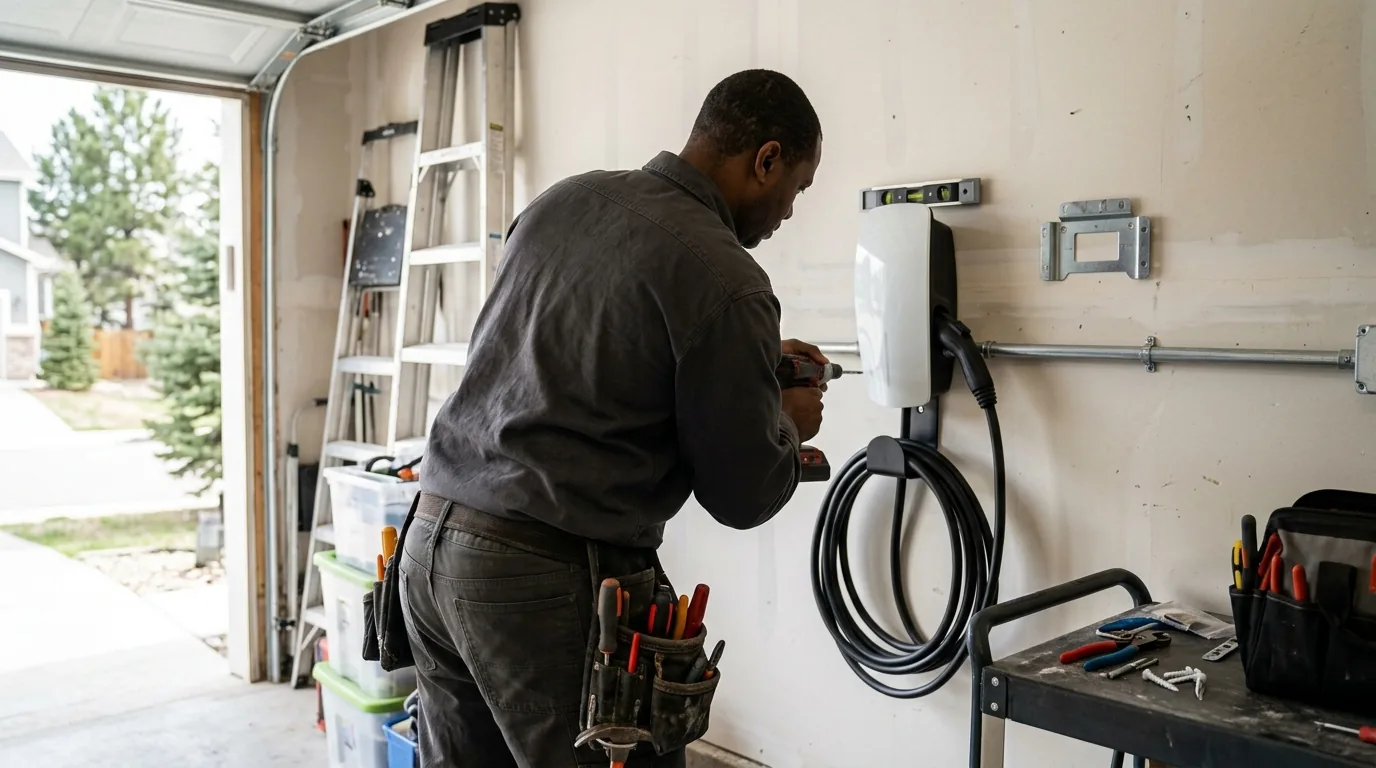
Home Charging in Greeley, Explained
Charging at a useful rate overnight is a circuit question first: a dedicated 240-volt run from the panel, a breaker of its own, an inspection at the end. Everything else — the length of the run, whether walls are finished, whether the panel has capacity, hardwired or receptacle — is what changes the scope and the price.
Greeley has public charging — an Electrify America station on Centerplace Drive rated 350 kW and ChargePoint equipment at Greeley Mall — and those are the right answer on a road trip. They are not the answer for a nightly commute: public fast charging costs more per mile than residential electricity and puts the driver in a queue.
Level 1 vs Level 2: What Actually Matters
What Level 1 Can and Cannot Do
A standard 120-volt outlet delivers about three to five miles of range per hour. That is workable for a plug-in hybrid, or for a driver covering under roughly 30 miles a day who can leave the car plugged in overnight. It is not workable for refilling a large battery from low — that can run past a full day.
What a Level 2 Circuit Adds
Step up to 240 volts and the same hour of charging returns 25 to 40 miles, which is why a full-EV household with an ordinary commute almost always ends up on Level 2. The difference shows up on the second or third day, not the first.
Why the City’s Fast Chargers Are Not a Home Option
DC fast charging is commercial-grade equipment that needs power a house does not provide. The 350 kW cabinet at Centerplace Drive exists to move a car through in twenty minutes on a trip. Home charging is Level 1 or Level 2.
Power, Panels, and Circuit Size
How Much Power Your Charger Needs
Home Level 2 chargers typically use a 40- or 50-amp circuit, supporting about 32 to 40 amps of continuous charging; some hardwired units use 60 amps for up to 48 amps of charging. Continuous loads run at no more than 80 percent of the circuit rating, so a 50-amp circuit supports a 40-amp charge rate. The circuit is sized to the vehicle and the panel, not picked from a chart.
The Load Calculation Comes First
Before a charger circuit is sized, the existing load is calculated: square footage, major appliances, heating and cooling, range, dryer, water heater, and existing large circuits. The charger is added to that picture. In Greeley’s older homes — where a gas range and gas heat often leave room on a 100-amp service — that calculation frequently comes back favourable. In a 1990s subdivision house with electric everything, it may not.
If Your Home Has 100-Amp Service
A 100-amp service can often carry an EV charger, particularly with gas heat, a gas range, and no hot tub. Electric heat or a heat pump plus electric appliances may leave no room for a 40-amp continuous load. The numbers decide, and the honest contractor shows you the arithmetic.
Panels With No Spare Capacity
A full panel with adequate service is a distribution problem, not a capacity problem — a subpanel or a different breaker arrangement can solve it. A full panel on a service that is already near its limit is a capacity problem, and the answer is a service upgrade or load management. Those are different jobs at different prices.
Hardwired or Plug-In?
A hardwired charger connects permanently, and its charging current still has to stay inside the circuit’s continuous-load allowance — for example 48 amps on a 60-amp circuit. A plug-in unit uses a dedicated 240-volt receptacle on the same circuit, which makes replacement easy and caps the charger at what the receptacle and its breaker allow. Both are legitimate; the choice usually comes down to the charger’s own rating and whether you want to swap units later without an electrician.
Outdoor and garage installations add another layer. An EV charging receptacle requires ground-fault protection; a hardwired unit relies on the personnel protection built into the equipment, with any additional protection that applies to the location and the circuit. Equipment installed outdoors must be rated for outdoor use. That is a design decision, not an accessory.
Greeley Permits and Inspection
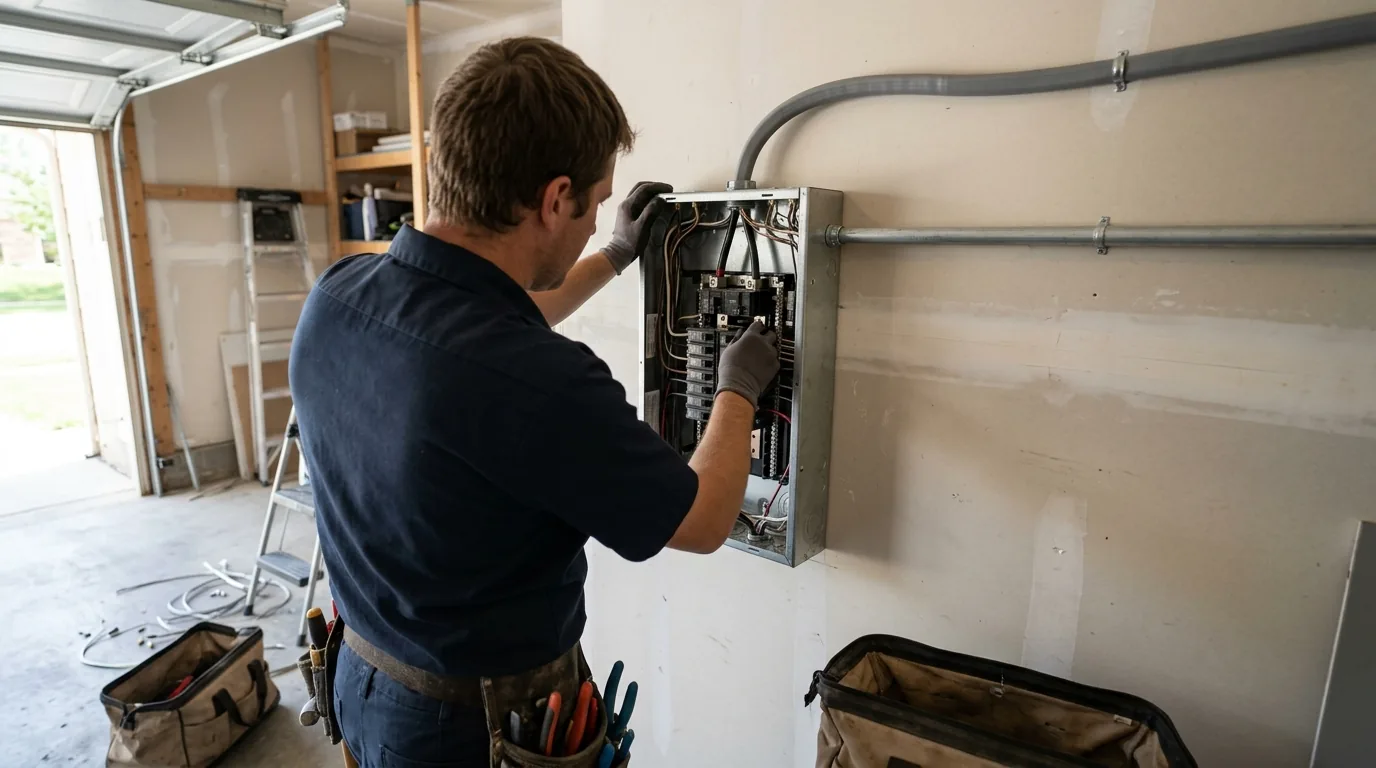
A new 240-volt circuit is permitted work. The City of Greeley Building Inspection department issues it at 1100 10th Street, Suite 114 — 970-350-9830 — with applications and inspections through the City’s eTRAKiT portal at trakit.greeleygov.com.
The City also publishes that a contractor licence will be required for permits starting January 1, 2027. If your install is planned across that date, it is worth asking who will hold the licence the City requires.
Inspection is where the circuit’s rating, the breaker, the conductor size, the grounding and the physical protection of the cable get checked by someone with no stake in the quote. It is also the point where an unpermitted install becomes visible — often years later, at a home sale.
Rebates and Utility Programmes
Greeley’s electricity comes from Xcel Energy — natural gas is supplied by Atmos Energy — and Xcel publishes residential EV charging programmes that change from year to year. Whether a given charger or wiring allowance applies depends on the account, the equipment and the programme’s current status, so check Xcel’s own pages for the terms in force rather than relying on an installer’s summary or a neighbour’s experience.
What we will not do is quote a rebate as a certainty. Programmes open, close and change eligibility, and a price that assumes a rebate which never arrives is not a price.
Our Installation Process
Site Visit and Load Calculation
We look at the panel, the service, the proposed parking location, and the route between them. The load calculation is done on the spot where the information exists.
Written Quote
The quote states the circuit rating, the charger arrangement (hardwired or receptacle), the wire route, whether drywall work is included, the permit, and any panel work needed to make room.
Install and Inspect
The circuit is run, protected and terminated, the charger mounted and commissioned, and the City inspection scheduled. You get a walkthrough of the charging rate the car will actually see and the breaker that protects it.
What Drives the Cost
The charger is usually the smallest part of the number. What moves the price: the distance from the panel and whether the route crosses finished walls; whether the panel has capacity or needs work; hardwired versus receptacle; the circuit rating; outdoor versus garage; permit fees; and any trenching or conduit run for a detached garage.
Prices circulating in community threads and social answers are worth reading carefully: they rarely state whether the figure covered a new circuit, a permit and an inspection, or only a swap on wiring that already existed. If a quote looks unusually low, ask what the permit line says and what the circuit scope is.
Related Work in Greeley
If the load calculation says the panel is the constraint, the answer is on the electrical panel replacement in Greeley page — a service upgrade and a panel swap are different jobs. The same charger work in neighbouring cities is covered on the Fort Collins EV charger page and the Windsor EV charger page; our service area covers the rest of Northern Colorado.
Frequently Asked Questions
Can I install an EV charger myself in Greeley?
A new 240-volt circuit is permitted electrical work, and a homeowner install is subject to the City’s permit and inspection process. Most insurers and most buyers treat an uninspected charger circuit as a defect at resale, which is why the permit is part of the job rather than an optional extra.
Will my 100-amp service handle a Level 2 charger?
Often yes, if the house heats with gas and the range is gas. It depends on the full load calculation, not on the service size alone. A house with electric resistance heat and an electric dryer is a different answer.
How long does an installation take?
A straightforward garage install a few feet from the panel is a half day’s work. A detached garage, a long conduit run, or panel work can make it a full day or more. The quote states the expected window.
Do I need a permit for a charger in Greeley?
Yes — a new 240-volt circuit is permitted work, applied for through the City of Greeley’s eTRAKiT portal and inspected by the City.
How many miles per hour will I actually get?
On a 40-amp charge rate most cars add roughly 25 to 30 miles of range per hour; a 48-amp rate adds more on vehicles that accept it. The car’s onboard charger is the ceiling, so a bigger circuit does not always mean a faster charge.
What about a Tesla or a plug-in hybrid?
The circuit is the same work; the connector differs. A plug-in hybrid with a small battery often does fine on Level 1, which is worth saying before anyone sells you a 60-amp circuit.


“ABSOLUTELY THE BEST. GREAT EMPLOYEES AND FANTASTIC COMMU ICATION. GREAT WORK”
Request an EV Charger Quote in Greeley
Send a photo of your panel and where the car parks, and we can tell you which circuit your house will support before anyone visits. Precision Service Electric is family owned, in business 30 years, licensed and insured under Colorado license #3918, and rated 4.8 stars across 47 Google reviews. Call 970-593-3190 or request a quote.