

In Erie, “EV charger installation” is a different question from “where do I charge” — the public stations around town are Level 2 posts in the 7 to 10 kW range and a DC fast charger on CO-7, none of which change what happens in your garage overnight. A home charger is a 240-volt circuit, a breaker, a load calculation and a Town of Erie electrical permit. Precision Service Electric installs Level 2 chargers in Erie and does the calculation before quoting. Call 970-593-3190.
Home Charging in Erie, Explained
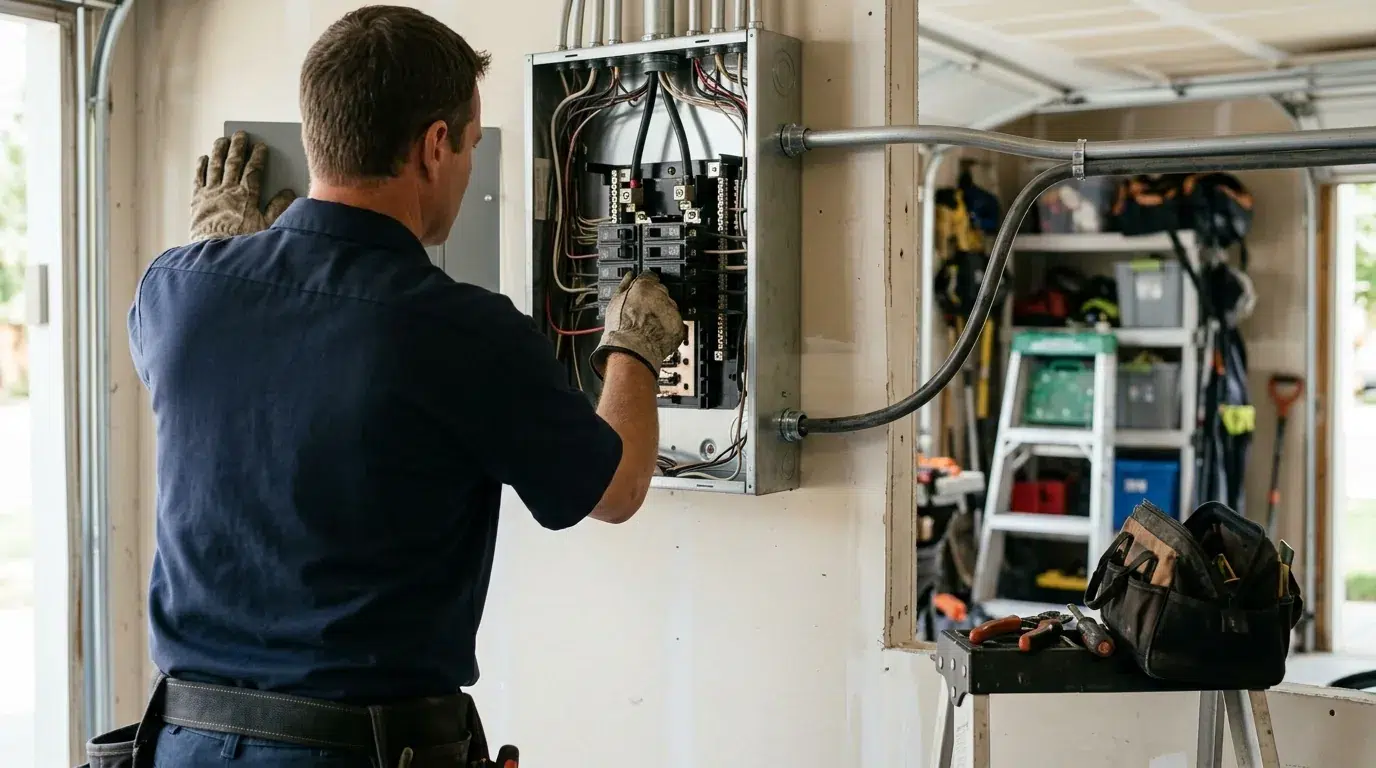
Home charging is a wiring project, not a shopping choice. The charger itself is the last item in a chain that starts at the panel: a dedicated circuit, its own breaker, a protected cable run to wherever the car actually sits, and an inspection at the end. The cord in the box connects to that circuit — it does not replace it.
What most Erie households need is a Level 2 unit on a 240-volt circuit where the car sits overnight. The charger brand, the amperage, hardwired versus outlet, and whether the panel has room all follow from the panel and the parking spot — in that order.
Level 1 vs Level 2: What Actually Matters
What Level 1 Can and Cannot Do
Level 1 uses a standard 120-volt outlet and adds roughly three to five miles of range per hour. For a plug-in hybrid, or a driver covering under about 30 miles a day, overnight Level 1 covers the daily need. Recharging a large battery from low can take well over a day.
What a Level 2 Circuit Adds
At 240 volts a Level 2 circuit puts back roughly 25 to 40 miles of range each hour. For a household with a full battery and a normal commute, that is the difference between charging whenever it suits and building the week around the car. Most Erie homes land here.
Why the Public Chargers Around Erie Are Not a Substitute
The ChargePoint posts at Pierce Street and Kattell Street and the Electrify America station on CO-7 are useful when you are out, and the DC fast charger will add range in minutes rather than hours. None of them replace charging while you sleep at your own rate, and none of them say anything about what your panel can carry.
Power, Panels, and Circuit Size
Circuit Rating vs. Charging Current
The two numbers people conflate are the circuit rating and the charging current. A 40-amp circuit supplies 32 amps of continuous charging, a 50-amp circuit supplies 40 amps, and a 60-amp hardwired circuit supplies 48 amps. Continuous loads run at no more than 80 percent of the circuit rating, which is exactly that arithmetic.
The Load Calculation Comes First
Before a charger circuit is sized, the existing load is calculated: square footage, major appliances, heating and cooling, range, dryer, water heater and existing large circuits. The charger is added to that picture. This is the step that separates an honest answer from a sales pitch, and it is the step a quote over the phone skips.
If Your Home Has 100-Amp Service
A 100-amp service often has enough headroom for a charger when the heavy loads are gas: heat, range, dryer, water heater. Swap those for electric versions and the same house can run out of room for a 40-amp continuous load. The arithmetic decides, and it changes house to house.
Panels With No Spare Capacity
Two hundred amps usually leaves space — usually is the word that needs testing. Where the service cannot take the added load, the real options are a service upgrade (a bigger panel by itself changes nothing), a charger dialled down to a lower amperage, or load management where the code permits it.
Hardwired Charger or a 14-50 Outlet?
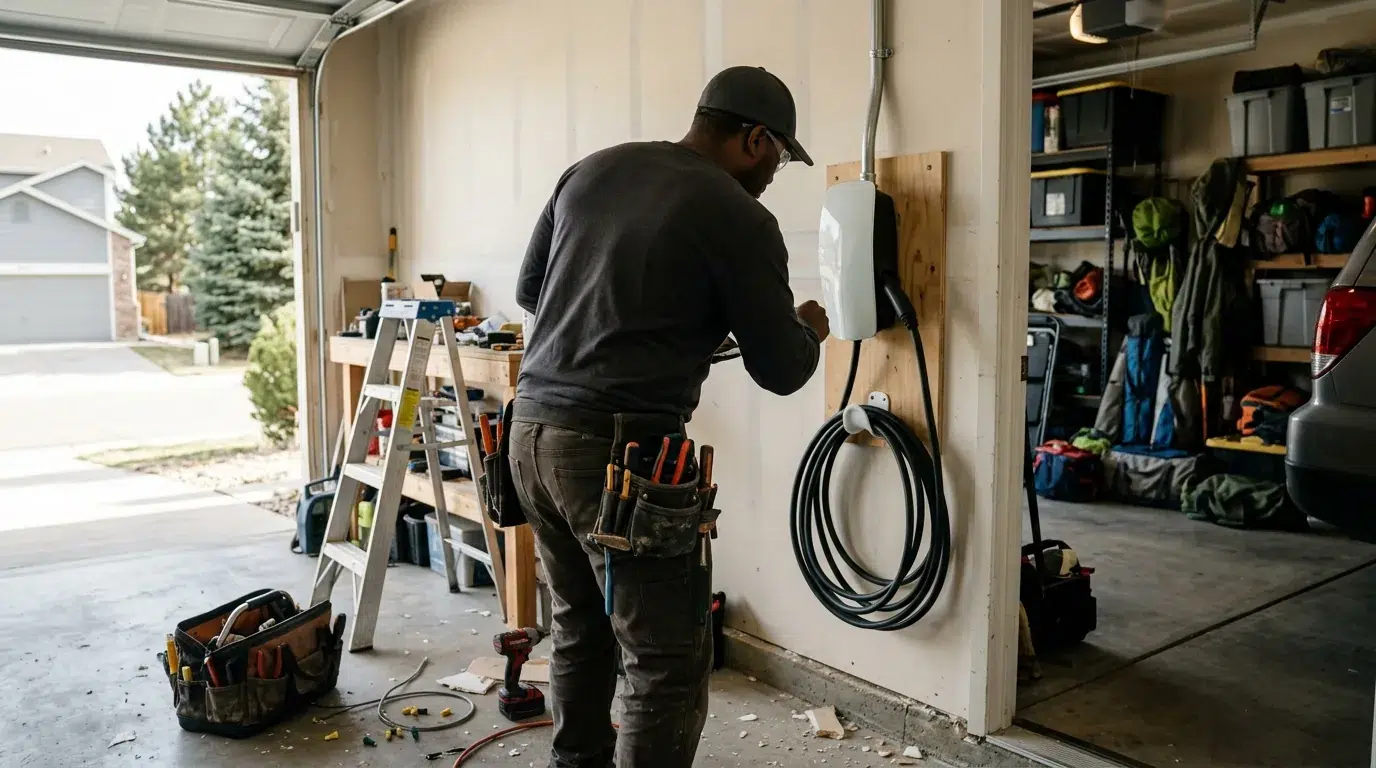
A hardwired unit connects straight to the circuit — no receptacle in the path, up to 48 amps on many models, and none of the nuisance tripping that comes with feeding a charger through a GFCI-protected outlet. Hardwired equipment installed outdoors can still call for ground-fault protection under the adopted code, and that is settled when the permit is pulled.
A NEMA 14-50 receptacle keeps the charger portable: unplug it, move it, replace it without an electrician. Either arrangement passes inspection; the trade is flexibility against the fastest charge the car will accept.
Permits and Inspection in Erie
A new charger circuit is permitted electrical work in Erie. The Town of Erie Building Division, 645 Holbrook Street, issues the permit — 303-926-2700 — and applications and inspections run through the Town’s eTRAKiT portal. The Town checks electrical licensing and apprentice supervision during its inspections.
Electrical contractors must hold a current State of Colorado licence with the company and master licence and insurance on file; the Town issues its own electrical licence at no cost. Precision Service Electric is licensed and insured under Colorado licence #3918 and pulls the permit for the circuit we install.
Which Utility Serves Your Erie Address?
Erie’s utilities depend on the address: the Town’s own provider list has both United Power, a cooperative, and Xcel Energy supplying electricity in different parts of town, and Xcel or Black Hills Energy supplying natural gas. That matters for rebates, because most EV charger incentives online are written for one utility’s territory and do not apply in the other. Check the provider on your own bill and read that utility’s current programme rather than an installer’s summary.
Off-peak savings depend entirely on the rate plan attached to the account — no window, no saving. Read the plan before building a schedule around it.
What the Installation Involves
It starts with the car, the parking spot, the daily mileage and whether a second EV is coming. From there the panel is inspected and the load calculated, then the cable route is worked out — through a garage wall, across a ceiling, or out to a detached garage. Installation sets the breaker, runs and protects the conductors, connects the equipment, tests it and books the inspection.
What EV Charger Installation Costs in Erie
No Erie installer publishes a price list, and any figure quoted before the panel is inspected is a guess. What actually moves the number: the length and difficulty of the run, whether walls are finished, whether the panel has capacity, hardwired versus outlet, and whether the charger sits indoors or outside.
The one comparison worth making is between home charging and public charging: home charging runs at your residential rate while you sleep, public Level 2 posts bill by the hour or the kilowatt-hour and DC fast charging bills at a premium. The installation is a one-time cost against years of that difference.
Serving Erie and Northern Colorado
We install EV chargers throughout Erie — Old Town, Vista Ridge, Kenosha Farm, Erie Village, Coal Creek and the 80516 ZIP code — and across the communities we serve from our Loveland shop: Fort Collins, Loveland, Windsor, Berthoud, Johnstown, Greeley, Longmont, Firestone, Timnath, Severance and Eaton. The full list is on our service area page.
For the same service elsewhere, see EV charger installation in Fort Collins and Windsor. If the circuit needs a service that can carry it, our panel replacement in Erie page covers that decision.


“Precision was prompt, the electrician was very knowledgeable, and the prices were great! They helped install new lights and ceiling fans. Highly recommend them to everyone!”
Request an EV Charger Quote in Erie
Tell us the vehicle, where it parks and when you are usually home. We check the panel, confirm the circuit size and quote it before any work starts. Call 970-593-3190 or send us a message. Office hours are Monday through Friday, 7:00 AM to 4:00 PM.
Precision Service Electric is family owned, in business 30 years, licensed and insured under Colorado licence #3918, with a 4.8-star Google rating across 47 reviews.
Frequently Asked Questions
Do I need a permit to install an EV charger in Erie?
Yes. A new 240-volt charger circuit is permitted work, issued by the Town of Erie Building Division and inspected through eTRAKiT. The permit and the passed inspection document that the circuit was installed to code.
Will my 100-amp panel support a charger?
Often yes — gas heat, a gas range and no hot tub usually leave room for a 40-amp charger circuit. Electric heat or a heat pump plus electric appliances can leave no capacity for a continuous 40-amp load. The load calculation decides.
Is a United Power rebate available for home chargers?
It depends on which utility serves your address — Erie’s provider list includes both United Power and Xcel Energy for electricity. Any incentive depends on that utility’s current programme, the equipment and your account, so check the provider on your bill and that utility’s own pages before counting on a figure.
How fast will a Level 2 charger fill my car?
Typically 25 to 40 miles of range per hour, depending on the vehicle’s onboard charger and the circuit. A 40-amp circuit supplies 32 amps of charging; a 60-amp hardwired circuit supplies 48.
Hardwire or 14-50 outlet?
Hardwiring supports higher amperage and avoids the GFCI breaker a 240-volt receptacle requires, which some chargers nuisance-trip. An outlet is more flexible if you may move or replace the equipment. Both are compliant and both are inspected.
Can the charger go on a detached garage?
Yes, with equipment rated for the location and a compliant circuit path — underground or overhead depending on the site and the existing supply. The installation is inspected like any other circuit.
Do I have to use the charger the dealer sold me?
No. The electrical side is what matters: the charger’s amperage requirement has to match the circuit, and the circuit has to match the panel’s capacity. Bring the unit you are considering and its specification gets checked against the installation.