

Finishing a basement is a construction project with an electrical spine: the rough-in happens before the drywall and cannot be done properly afterwards, the inspection happens before the drywall goes up, and every decision about outlets, lighting and circuits gets locked in early. Precision Service Electric handles the electrical side of Greeley basement finishes — rough-in, trim, panel work, inspection — on its own or alongside a general contractor’s schedule. Call 970-593-3190.
Why Basement Electrical Is Different
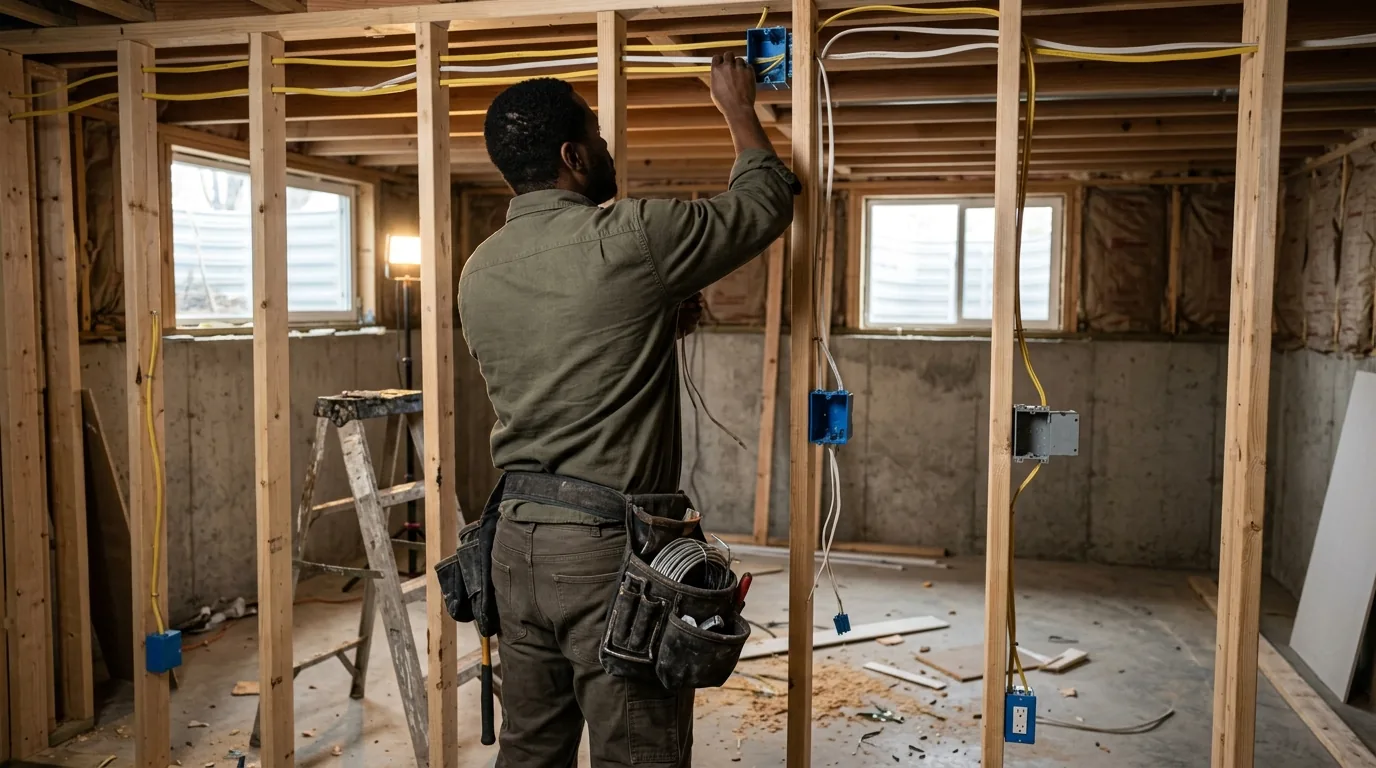
A finished basement has no attic above it and no crawlspace beneath it. Once the ceiling closes, adding a circuit means opening the ceiling. That single fact drives the whole discipline of the job: the layout of every outlet, switch, fixture, smoke alarm and data point is decided while the framing is still visible, because changing it later costs a repair rather than an hour.
Concrete is the second difference. Exterior walls are concrete or masonry, which means furring and insulated framing before any wiring runs, and it means the electrical boxes are set out from the wall rather than inside a stud bay like they are upstairs.
The Sequence That Cannot Be Compressed
Rough-In
Framing in place, wiring run and boxes set, panel work done if the basement needs its own circuits. The rough-in is inspected before insulation and drywall — an inspector has to see the wire while it is still visible.
Insulation and Drywall
After a passing rough inspection. Anything discovered after this point is a change order with a repair attached.
Trim
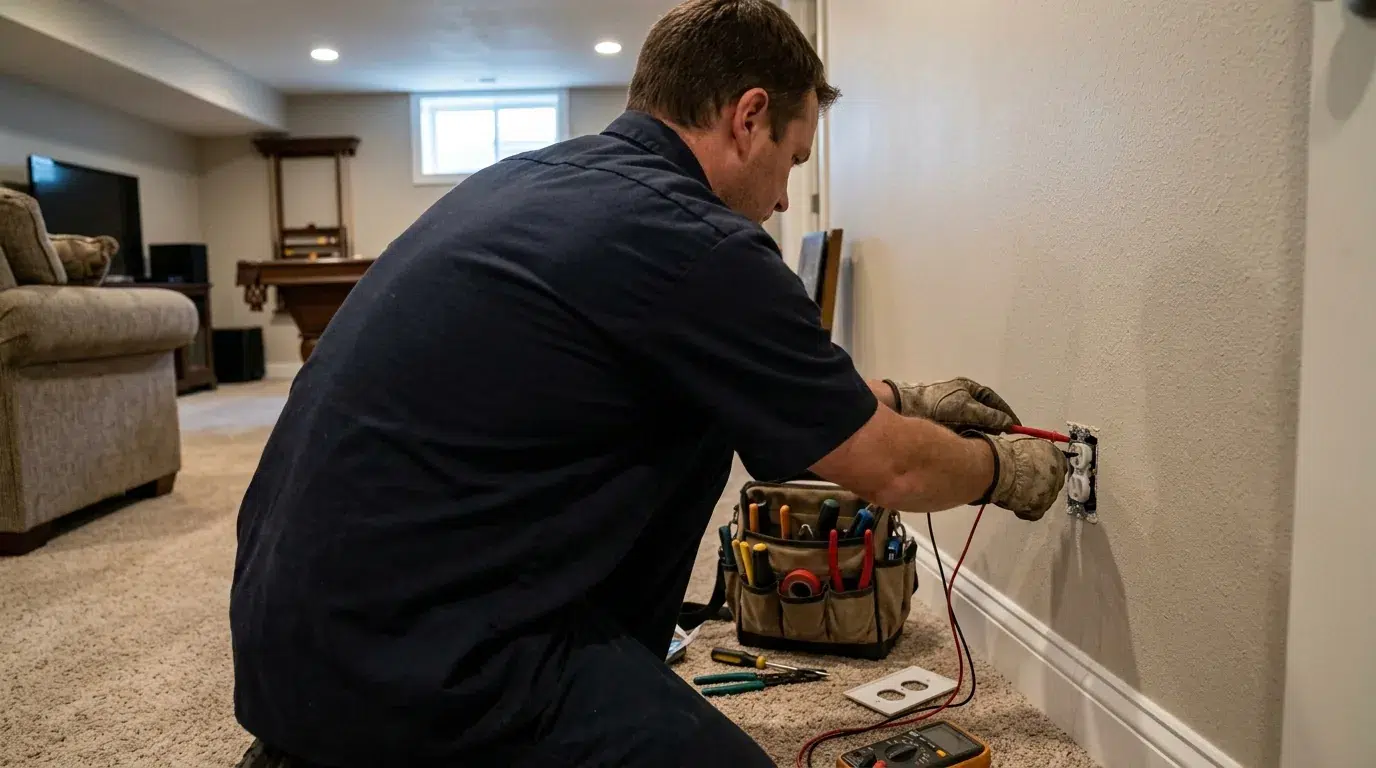
Devices, plates, fixtures, smoke detectors and any final connections once the surfaces are finished. Then the final inspection.
Why the Order Slipped Once Slips Everything
When a homeowner asks a general contractor to “handle the electrical at the end”, the sequence either breaks the schedule or the electrical gets done badly behind a closed wall. It is worth asking, before a contract is signed, when the electrical rough-in inspection is scheduled.
Circuits for a Finished Basement
A typical finish adds a lighting circuit, a general receptacle circuit or two, dedicated circuits for any kitchenette or bar, and dedicated circuits for large equipment — a treadmill, a heater, a sump pump. Receptacles in a basement require ground-fault protection, including receptacles in dry finished rooms, subject to the code’s specific exceptions; arc-fault protection also applies to the covered living-space circuits, including bedrooms. The exact scope follows the room’s use and the code edition the City enforces.
Where the basement is being used as a legal sleeping room, the egress requirement is the one that changes the design most — a window well or a walkout door, and the alarm and lighting requirements that go with it. That is a building question first and an electrical one second, but both are settled at the design stage.
Subpanels: When They Help and When They Do Not
A subpanel is a distribution solution: it puts breakers near the loads and shortens the wire runs. It does not create capacity. If the main service is already near its limit, a subpanel just extends the limit to a new location.
Where the basement is adding a kitchenette, a bathroom, a home gym and a shop bench, the load adds up — and the load calculation, not the panel count, decides whether the house can carry it.
Lighting and Outlet Planning
Basement rooms are usually low-ceilinged, which changes the lighting answer: recessed fixtures at the right spacing, wall-washing where the ceiling is lowest, and switching that lets the room work for two purposes. A basement that gets one central fixture per room looks like a basement; one with layered lighting looks like a room.
Outlet placement is the other decision that cannot be revisited. Television and media locations, desk and workbench positions, network and data runs, and where furniture will actually sit — agreed on paper while the walls are open.
Permits and Inspection in Greeley
A basement finish is permitted work, and the electrical scope runs inside that permit. The City of Greeley Building Inspection department — 1100 10th Street, Suite 114, 970-350-9830 — takes applications and schedules inspections through the City’s eTRAKiT portal at trakit.greeleygov.com.
The City publishes that a contractor licence will be required for permits starting January 1, 2027, which is a scheduling consideration for any project starting this winter.
Expect two inspections: rough and final. Budget for the rough inspection before drywall, because a contractor who misses it and closes the walls has created a problem that only demolition solves.
Working With a General Contractor
Most homeowners hire one contractor to run the finish and an electrician for the electrical scope. That works well when the schedule is shared: the electrician needs the framing complete and the layout fixed, and the general contractor needs the rough inspection passed before insulation.
A good electrical scope document states what is included — number of outlets, fixtures, switches, smoke alarms, panel work — so that nobody discovers a gap at trim.
What Drives the Cost
Basement electrical is priced from the plan, because the plan is the only thing that predicts the work: the number of circuits, whether a subpanel is needed, how far the panel is from the basement, the fixture count, whether the ceiling is drywall or accessible, and how much of the work is a change to existing wiring rather than new.
The cheap version of this job is the one where the layout was agreed up front. The expensive version is the one where a wall gets opened after final inspection.
Related Work
The same scope is covered for Fort Collins basement finishes and Windsor basement finishes. Basement lighting usually belongs with lighting upgrades in Greeley, and where the panel is the constraint, the answer is on the Greeley panel replacement page. Our service area covers the rest of Northern Colorado.
Frequently Asked Questions
Do I need a permit to finish my basement in Greeley?
Yes. A basement finish is permitted work, and the electrical scope is inspected inside that permit — rough before drywall, final after trim.
How long does the electrical rough-in take?
A typical basement finish is a few days of rough-in work depending on size and fixture count. The schedule constraint is usually the inspection window rather than the labour.
Can I add a bathroom or kitchenette to my basement?
Yes, and it changes the electrical scope substantially: dedicated circuits, ground-fault protection, ventilation, and often a load calculation for the added appliances. It is worth planning before framing rather than during.
Does my basement need arc-fault breakers?
Bedrooms and most living-space circuits in a basement finish require arc-fault protection, with the exceptions the code allows. The exact scope follows the room’s use and the code edition the City applies.
Will finishing the basement overload my panel?
That is what the load calculation answers. A 200-amp service with gas appliances usually has room for a basement finish; a 100-amp service with electric heat may not. A subpanel does not change the answer.
Can you work with my general contractor?
Yes — most of our basement work is on a shared schedule, with the electrician taking the electrical scope and the general contractor running the finish.


“Calvin does phenomenal work and is extremely respectful. Great work!”
Request a Basement Electrical Quote in Greeley
Send the plan if you have one, or the room dimensions and intended use if you do not, and the conversation starts with the layout. Precision Service Electric is family owned, in business 30 years, licensed and insured under Colorado license #3918, and rated 4.8 stars across 47 Google reviews. Call 970-593-3190 or request a quote.