

A whole house fan moves a lot of air through a house in a few minutes, and every cubic foot of it has to leave through the attic. That second half is where most installations fail quietly: the fan runs, the house does not cool, and nobody measures why. Firestone’s mix of 1970s south-side housing and newer Carbon Valley subdivisions produces both versions of the problem. Precision Service Electric installs whole house fans in Firestone. Call 970-593-3190.
How a Whole House Fan Works Here
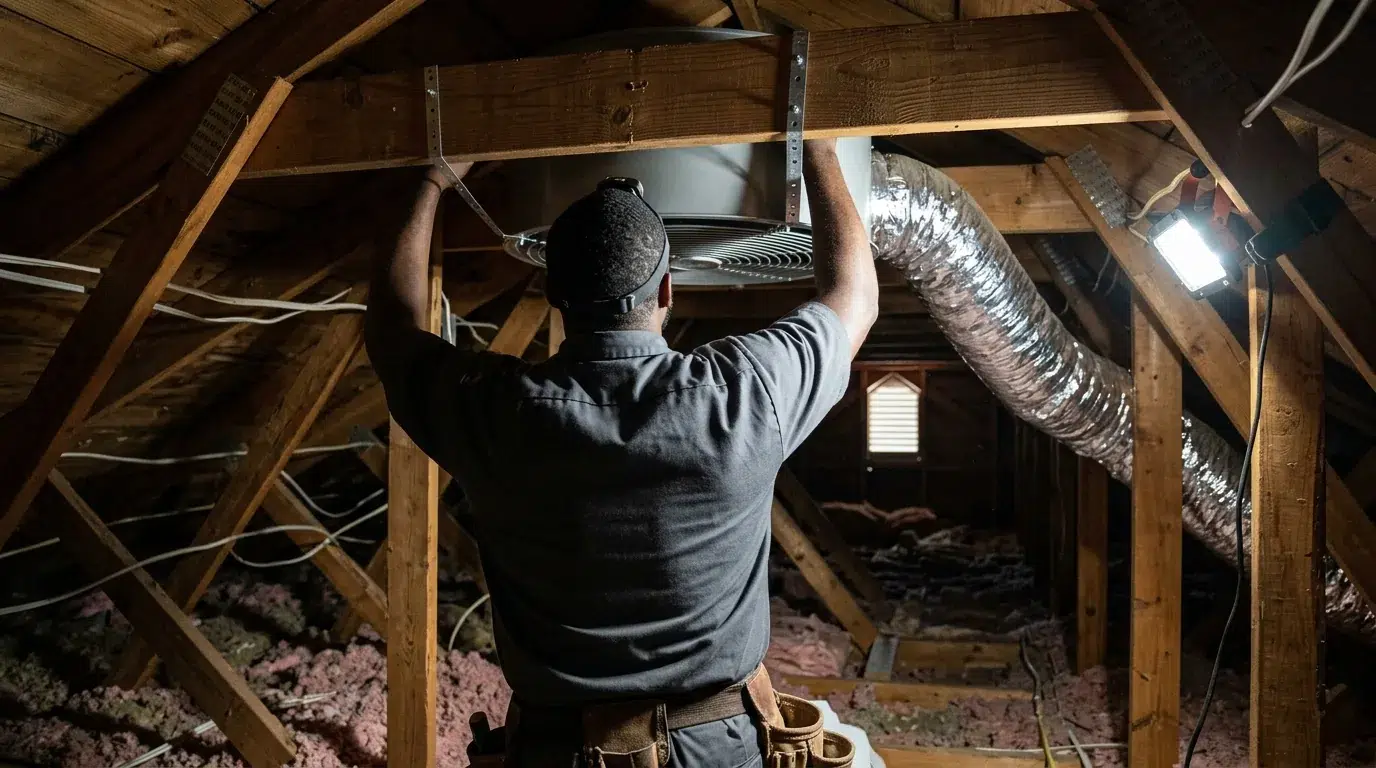
The fan sits in the ceiling, usually over a hallway, and exhausts house air into the attic, where it escapes through the attic vents. Open a couple of downstairs windows and cooler evening air is drawn through the rooms on its way out. Nothing is refrigerated; the building is flushed with outside air, which is why the system is excellent at nine at night in July and useless at four in the afternoon.
That also explains the rule people get wrong. Shut the windows and the fan has nowhere to pull from, so the house depressurises instead. Open enough windows before running the fan, and have combustion appliances and any fireplace evaluated for backdrafting under operating conditions before the fan is commissioned, because depressurisation is exactly the condition that can pull flue gases the wrong way.
The honest limits are worth stating: this is a shoulder-season and evening device, and on a wildfire-smoke day it is the last thing you want running.
Attic Venting Comes First
A fan rated at 3,000 CFM moves that volume only if the attic can get rid of it. The preliminary guideline used across the industry is one square foot of net free vent area per 750 CFM of fan rating — and net free area is not the size of the vent opening; each vent has a manufacturer rating, and that rating is what counts.
It is a guideline, not a code requirement, and the fan manufacturer’s installation instructions govern. Soffit vents blocked by an extra layer of insulation, a ridge vent with no intake path, or a single gable vent on a large attic each produce the same result: pressure in the attic, reduced airflow, and attic air pushed back through ceiling penetrations into the rooms below.
We measure the existing relief area and look at whether the soffit path is open before selecting a fan. If the attic needs more venting, that belongs in the quote — not in a second visit after the fan disappoints.
Fan Options for a Firestone Home
Sizing starts from the volume being flushed: conditioned square footage times ceiling height, then a target number of air changes per hour that suits how the household uses the house. A 1,800-square-foot home with eight-foot ceilings is about 14,400 cubic feet; dividing that by a nominal 3,000 CFM gives roughly 4.8 minutes, though installed airflow and air changes per hour are what a real installation is actually judged on.
Noise is the specification people forget. Two fans with identical airflow can differ by around ten decibels — the gap between a conversation and a raised voice — and ducted, insulated units are markedly quieter than direct-drive boxes. Two-speed and app-controlled units matter more than they sound like they would, because most of the time you want the low setting at bedtime rather than the full blast at dinner.
Ceiling-mounted versus attic-mounted affects both noise and service access, and the damper and insulation detail at the ceiling opening decides how much winter heat escapes upward when the fan is off.
The Electrical Work Involved
Whether a dedicated circuit is needed, and what size it has to be, depends on the fan’s electrical rating, its installation instructions, the calculated load and the applicable code — a small direct-drive unit and a larger two-speed unit do not land in the same place. A service disconnect within sight is required where the code requires it, and the control wiring for a two-speed or timer setup is part of the job rather than an accessory.
This is the point where a fan installation becomes an electrical project. If the panel is full, the circuit question becomes a panel question, which is why we look at the panel before quoting the fan.
Permits in Firestone
The Town of Firestone Building Division at 9950 Park Avenue, 303-833-3291, issues electrical permits through the CitizenServe portal and performs inspections in house under the 2023 National Electrical Code. Firestone requires permits for electrical changes, so a new dedicated circuit brings the permit with it; ceiling or venting alterations can bring building review alongside.
Electricians need the Town’s no-fee contractor licence, with proof of state licensure and a certificate of insurance naming the Town as certificate holder and additional insured, renewed annually. The fire district is not part of this path — its own fee schedule states that district permits are not required for one- or two-family homes or townhomes.
Our Process
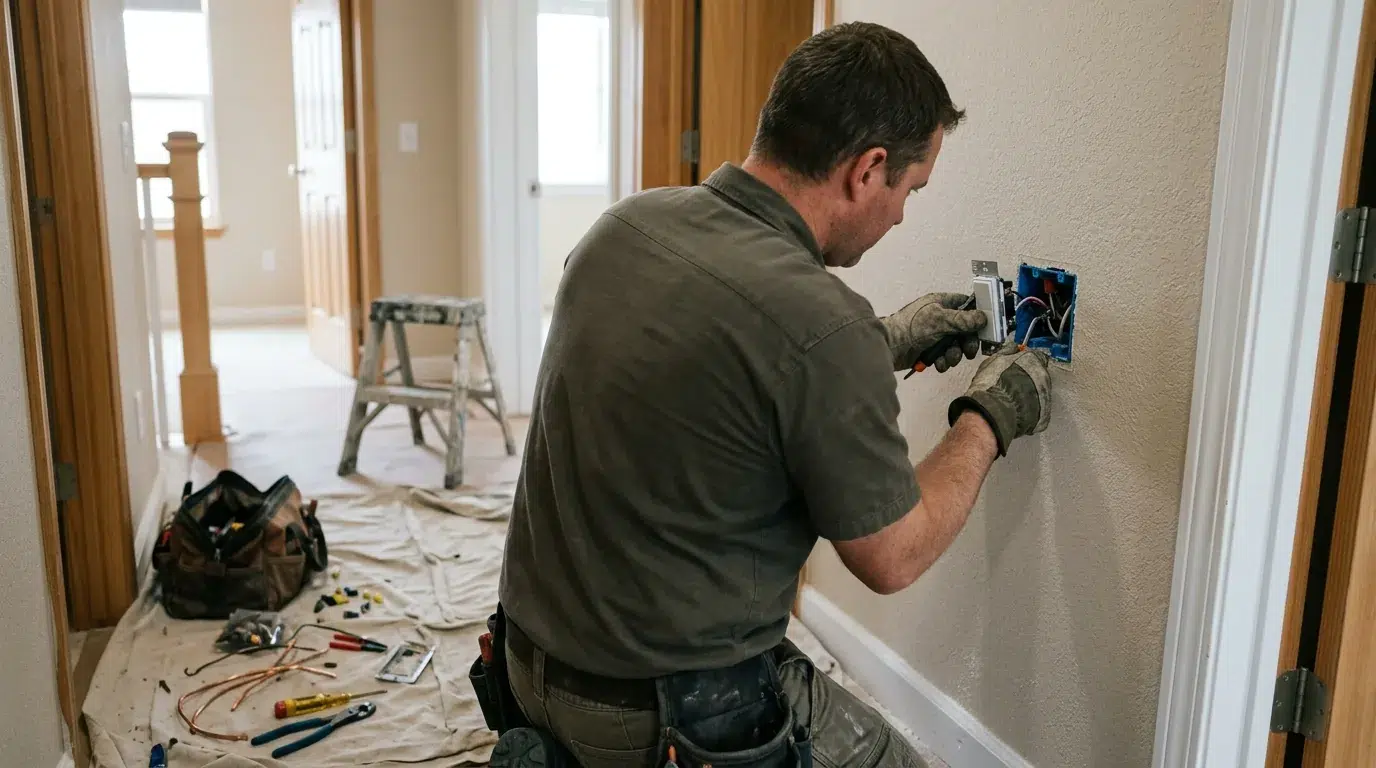
In-home check, then verification of the attic’s relief area and the soffit path, then fan selection and sizing against the actual volume, then the Town permit, then the dedicated circuit and control rough-in, the ceiling and attic opening with the damper detail, mounting and sealing, a test and balance with windows open, and the inspection.
What Moves the Price
Unit tier and airflow, whether the attic needs additional relief venting, the circuit and its distance from the panel, the control package, and ceiling access. A single-storey ranch with a walkable attic is the easy case; a vaulted ceiling with no attic access over the hallway is where the labour goes.
We quote the fan, the venting work and the electrical as separate lines, because they are separate decisions and because the venting is what determines whether the money was well spent.
Related Work in Firestone
The circuit starts at the panel — see panel replacement in Firestone if the spaces are gone. For another town’s version of this job, read the Longmont whole house fan page or the Berthoud page, or start from our service area.


“Precision was prompt, the electrician was very knowledgeable, and the prices were great! They helped install new lights and ceiling fans. Highly recommend them to everyone!”
Frequently Asked Questions
Do I need a permit for a whole house fan in Firestone?
A permit is generally required when the installation includes a new electrical circuit, and electrical changes are permitted work in Firestone; we confirm the requirements for the specific installation with the Building Division. Ceiling or venting alterations can bring building review with them.
Does a whole house fan replace air conditioning?
No. It replaces evening and overnight cooling and does nothing for a mid-afternoon 95-degree day. Most households that install one use the air conditioning less, not never.
Why do the windows have to be open?
The fan exhausts air into the attic and out the vents, so it needs a path for outside air to enter the house. Without open windows the house depressurises and the fan moves much less air.
My attic only has a ridge vent — is that enough?
Often not. The attic needs relief area as well as an exhaust path, and the preliminary guideline is one square foot of net free vent area per 750 CFM, measured by each vent’s rated net free area rather than its opening size.
Is there a rebate for a whole house fan in Firestone?
Not that we can find. United Power, the co-operative that supplies Firestone, lists rebates for thermostats, EVs, efficient heating and cooling, and electric water heating — not for whole house fans.
How loud is it?
That depends on the unit. Two fans with the same airflow rating can differ by around ten decibels, and ducted insulated models are much quieter than direct-drive boxes. It is worth choosing on sound as well as airflow.
Request a Whole House Fan Quote in Firestone
A photo of the attic from the hatch and one of the open panel tells us most of what we need. Precision Service Electric is family owned, in business 30 years, licensed and insured under Colorado license #3918, factory-trained and an authorized Generac dealer, and rated 4.8 stars across 47 Google reviews. Call 970-593-3190 or request a quote.