

A whole house fan is the cheapest comfort upgrade a Berthoud house can get, and the one most likely to disappoint — because the fan is not the part that decides whether it works. The attic venting does. Precision Service Electric installs whole house fans here, and measures the attic before quoting one. Call 970-593-3190.
Why the Attic, Not the Fan, Decides the Result
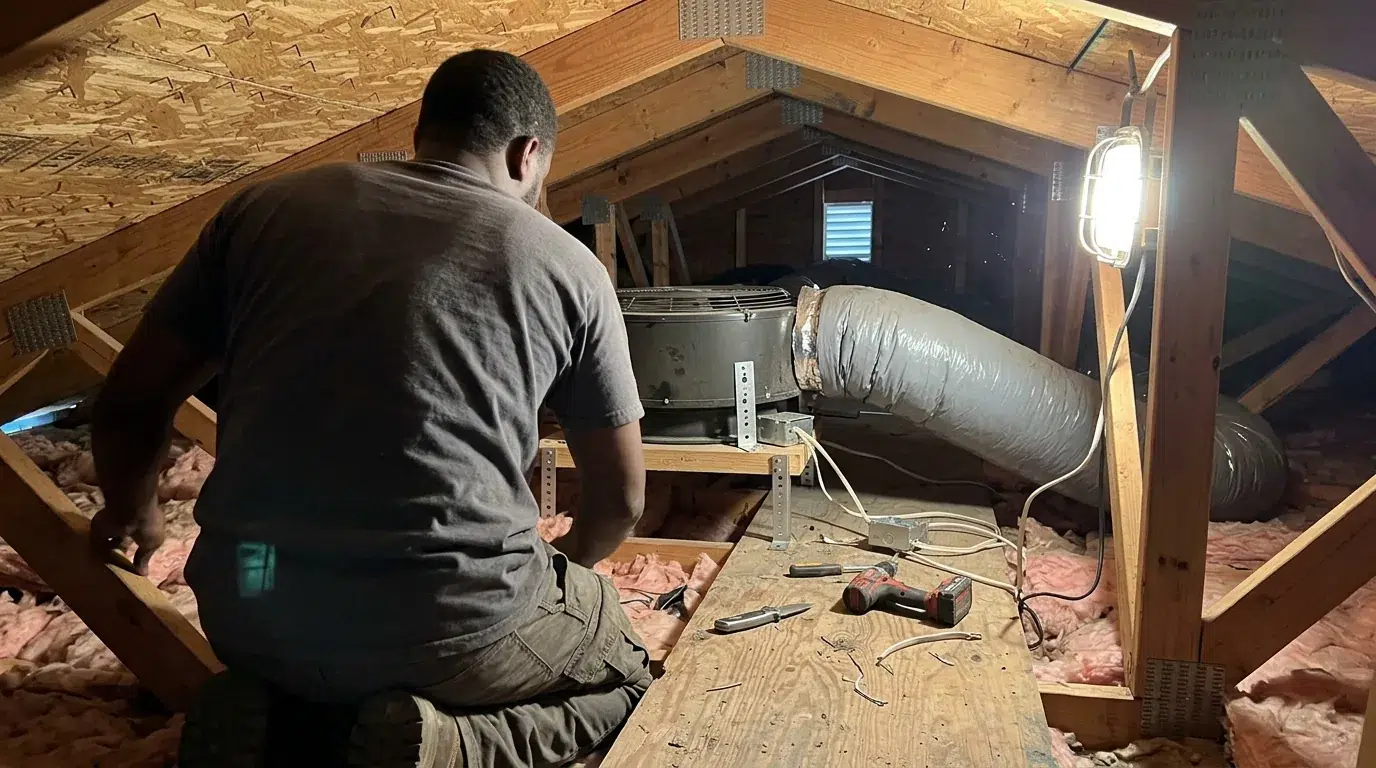
A whole house fan does not cool air. It moves it. The fan pulls outside air in through open windows and pushes the hot air that has been sitting in the house — and in the attic above it — back outside. When the attic has somewhere to send that air, the house flushes in minutes. When it does not, the fan pressurises the attic, the flow drops to a fraction of its rating, and the motor runs hot while the house stays warm.
That is the failure mode almost nobody warns buyers about, and it is invisible at the moment of purchase: the fan sounds like it is working. It is working — into a closed box.
How Much Venting a Berthoud Attic Needs
A common preliminary guideline is one square foot of net free attic relief per 750 cubic feet per minute of fan capacity — a starting point for sizing the exhaust path, not a code requirement, and the manufacturer’s own installation instructions govern. Net free area is not the same number as the size of the vent: a stamped soffit vent and a ridge vent each publish their own net free figure, and it is always smaller than the opening. Old and re-roofed houses are routinely under-vented, because ridge venting gets added to soffit venting that was already blocked by insulation.
So the first thing we do on a Berthoud house is look at the attic rather than the hallway ceiling: measure the existing intake and exhaust, check whether the soffit vents are clear, and work out what the proposed fan would actually need. If the venting is short, remediating it becomes part of the scope rather than a surprise afterwards.
What a Whole House Fan Actually Does for the House
On a Northern Colorado evening, when the outside temperature drops ten to fifteen degrees below the indoor temperature, a fan replaces air-conditioned air with cool outside air in a few minutes. It also pulls the heat out of the structure itself, which is why the house stays comfortable into the next morning rather than snapping back the moment the fan stops.
What it does not do is replace air conditioning. On a 95-degree afternoon with no temperature drop, there is nothing to pull in. The honest framing is that the fan handles the evenings and the shoulder seasons, and the air conditioner handles the peak — the two are complementary rather than alternatives.
The Electrical Side
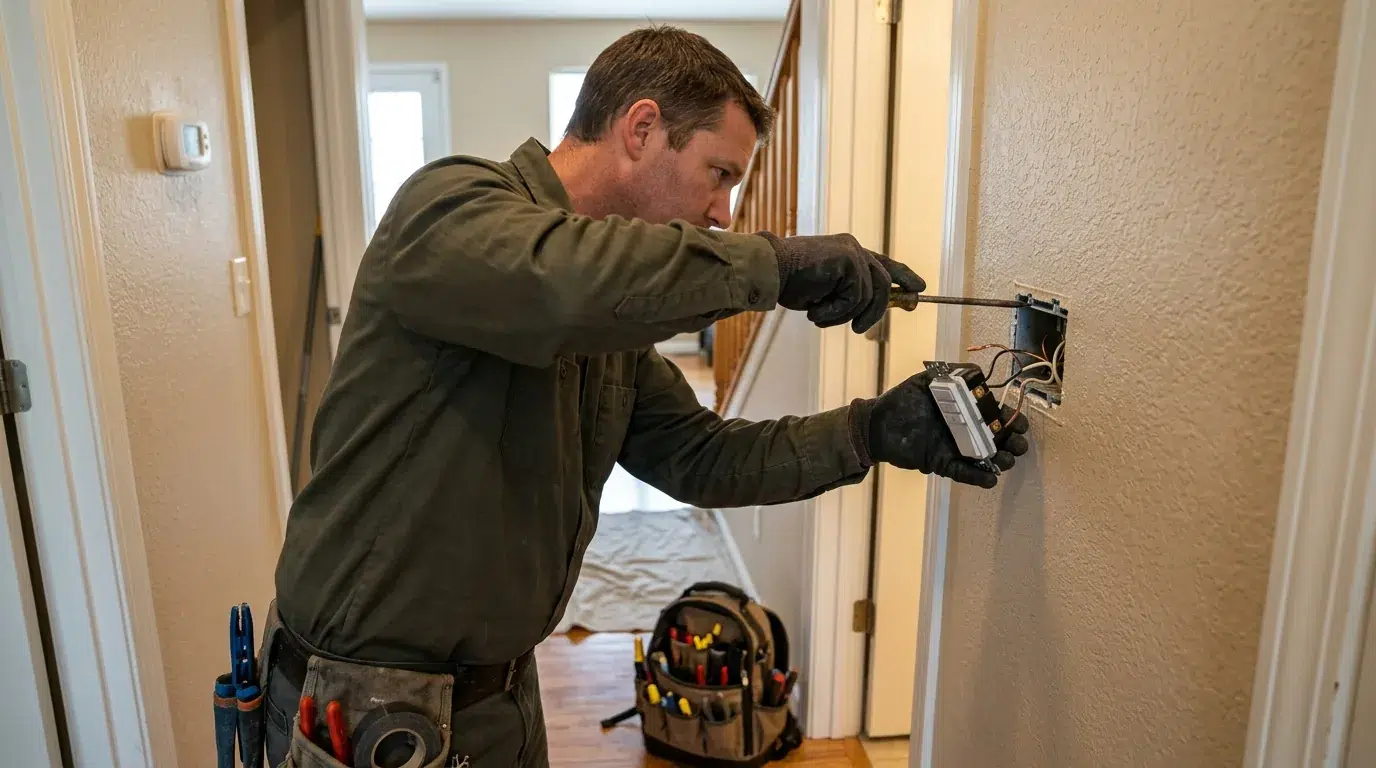
A fan is a motor on a roof or in a ceiling, and it needs a circuit. The requirement depends on the unit: some small fans run on an existing circuit, and most whole-house units want a dedicated circuit sized to the motor. The control is wired to a wall location, and on a two-speed or variable unit that means additional conductors.
The attic is also an environment. Junction boxes have to remain accessible, conductors have to be protected where they cross framing, and the fan’s own connection has to be made in a way that survives the temperature swing. This is the part a handyman install skips, and it is the part an inspection looks at.
Permits in Berthoud
A whole house fan installation can trigger more than one permit. The electrical side is permitted where a circuit is added or altered; the building side comes in where the ceiling or the attic venting is cut. Inside town limits the Town of Berthoud Building Department at 807 Mountain Avenue handles it, with applications through the CommunityCore portal under the Town’s adopted 2024 I-Codes.
Berthoud also requires a business licence and a contractor licence to work in town, and the licensing review happens inside the permit process. Properties outside the town limits fall under Larimer or Weld County depending on the address, and we confirm which before quoting — the town straddles both.
Sizing and Noise
Sizing follows the volume of the house, not the number of bedrooms on a brochure. A rule-of-thumb starting point is a fan that exchanges the house air several times an hour, which for a typical Berthoud house lands in the middle of the residential range rather than at either extreme.
Noise is where cheap units lose. A fan rated in the low thousands of CFM mounted in a hallway ceiling is loud enough that people stop using it. Two-speed controls, insulated ductwork and a unit designed for the application make the difference between a fan that runs every evening and one that runs twice a year.
What It Costs
Price follows three things: the fan and its control, the circuit, and whatever the attic needs. A house with adequate venting and a short circuit run is the low end. A house that needs additional intake venting, a long conduit run, or a new circuit is a different job entirely.
Any range quoted without looking at the attic is a range for the fan, not for the installation. We quote the fan, the electrical scope and the venting separately so it is clear which part is which.
Related Work in Berthoud
The same installation in the neighbouring towns is on the Longmont whole house fan page and the Loveland fan page. Where the fan needs its own circuit, panel replacement in Berthoud covers the capacity question, and our service area covers the rest of Northern Colorado. The same installation is written up for Fort Collins and Windsor.


“Calvin and Cade install a porch fan and R&R a roof fan motor. They were professional, courteous, respectful, knowledgeable and expeditious examples for Precision Service Electric.”
Frequently Asked Questions
Do I need a permit for a whole house fan in Berthoud?
Often, yes — the electrical side where a circuit is added, and the building side where the ceiling or venting is altered. The Town of Berthoud Building Department confirms the scope for the specific installation.
Can my attic handle a whole house fan?
That is the question to answer first. It needs enough net free intake and exhaust vent area for the fan’s rating; if it is short, the fan underperforms regardless of quality. We measure before quoting.
Is a whole house fan a replacement for air conditioning?
No. It works when outside air is cooler than inside air — evenings, nights and shoulder seasons. On a hot afternoon there is nothing useful to pull in, and the air conditioner does that job.
How loud is it?
Depends on the unit and where it sits. A variable-speed unit on a low setting is quiet enough to talk over; a single-speed budget unit in a hallway ceiling is not. We specify for the room it serves.
How big a fan does a two-storey house need?
Sized on the volume of the house and the venting available, not on storey count. A taller house has more air to move, but the attic capacity is usually the binding constraint.
Does it work with the windows closed?
No. The fan needs makeup air; with every window shut it has nowhere to draw from, which depressurises the house and can pull exhaust gases back down a flue. Open the windows in the rooms you want cooled, on the shaded side if there is one, and follow the manufacturer’s operating instructions.
Request a Whole House Fan Quote in Berthoud
Send a photo of the attic from the access hatch, the ceiling where the fan would go, and the panel, and the answer comes back with the venting arithmetic attached. Precision Service Electric is family owned, in business 30 years, licensed and insured under Colorado license #3918, factory-trained and an authorized Generac dealer, and rated 4.8 stars across 47 Google reviews. Call 970-593-3190 or request a quote.