


A whole house fan is the cheapest cooling upgrade a Longmont house can get, and the one most often installed into an attic that cannot vent it. The fan is simple; the building around it is not. Before a model is chosen, the attic’s venting is measured, because a fan that cannot exhaust the air it moves pressurises the attic and stops doing its job. Precision Service Electric installs whole house fans in Longmont and starts with that check. Call 970-593-3190.
What the Fan Actually Does
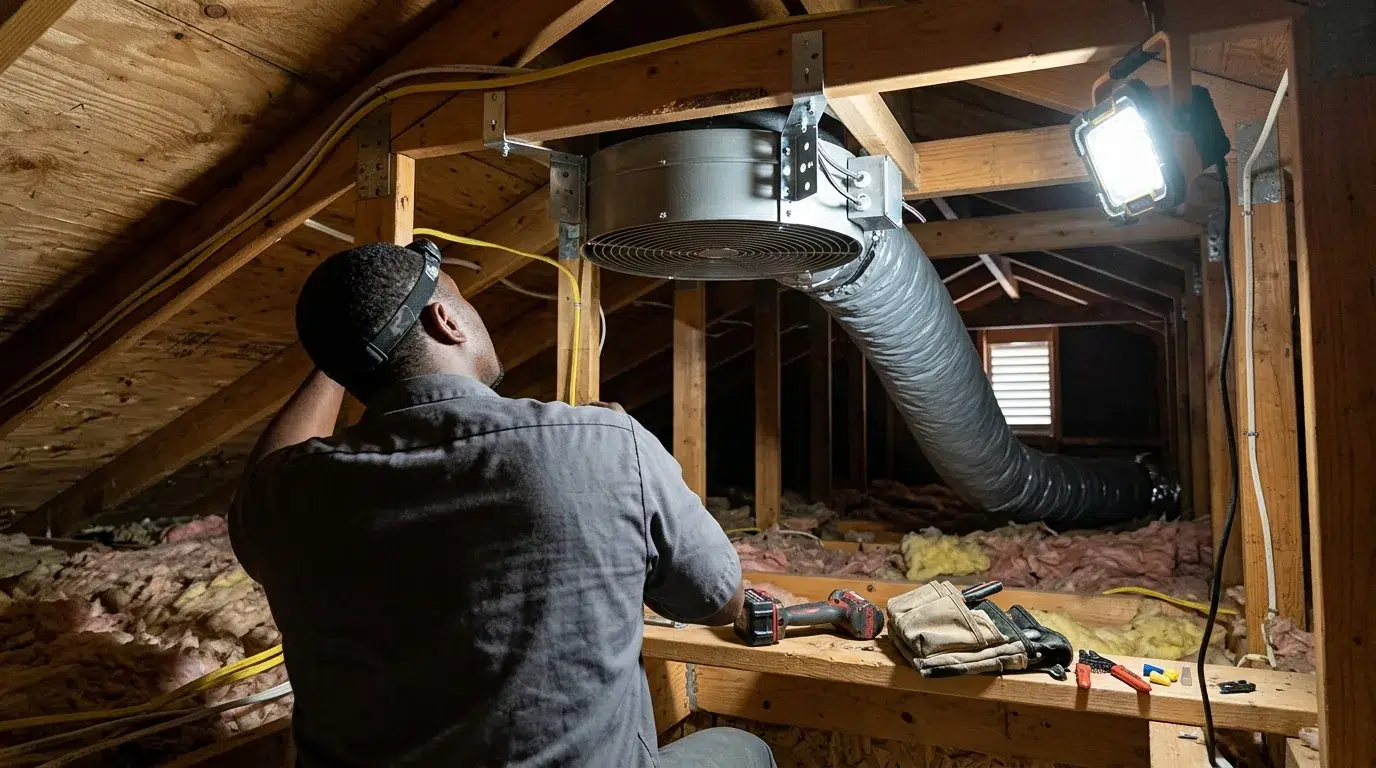
It pulls outside air in through open windows and pushes the house’s warm air out through the attic vents. On a Longmont evening when the outside temperature has dropped ten degrees and the house has been closed all day, that exchange takes minutes rather than hours — which is why the fan is often described as the reason the air conditioner does not run at night.
What it does not do is cool or dehumidify. It moves air. On a still, warm evening with nothing cooler to pull in, there is nothing to move, and a house that needs a fixed temperature all day is not a fan house.
The Attic Is the Real Constraint
Net Free Area, Measured Not Counted
Attic venting is measured in net free area — the open area left after the screens, louvers and bug mesh are accounted for. The working rule is about one square foot of net free vent area per 750 CFM the fan moves, which puts a 3,000 CFM unit at roughly four square feet.
Many Longmont attics have two gable vents and a run of soffit slots, which often comes nowhere near that. The correction is additional soffit or ridge venting — roofing-adjacent work that has to be in the quote rather than discovered on install day.
Why Under-Venting Fails Quietly
A fan in an under-vented attic still sounds like it is working. What happens instead is that pressure builds, air finds its way back through the ceiling penetrations, and the house pulls conditioned air out of itself rather than drawing cool air in. The fan runs; the house does not cool.
The Circuit and the Control
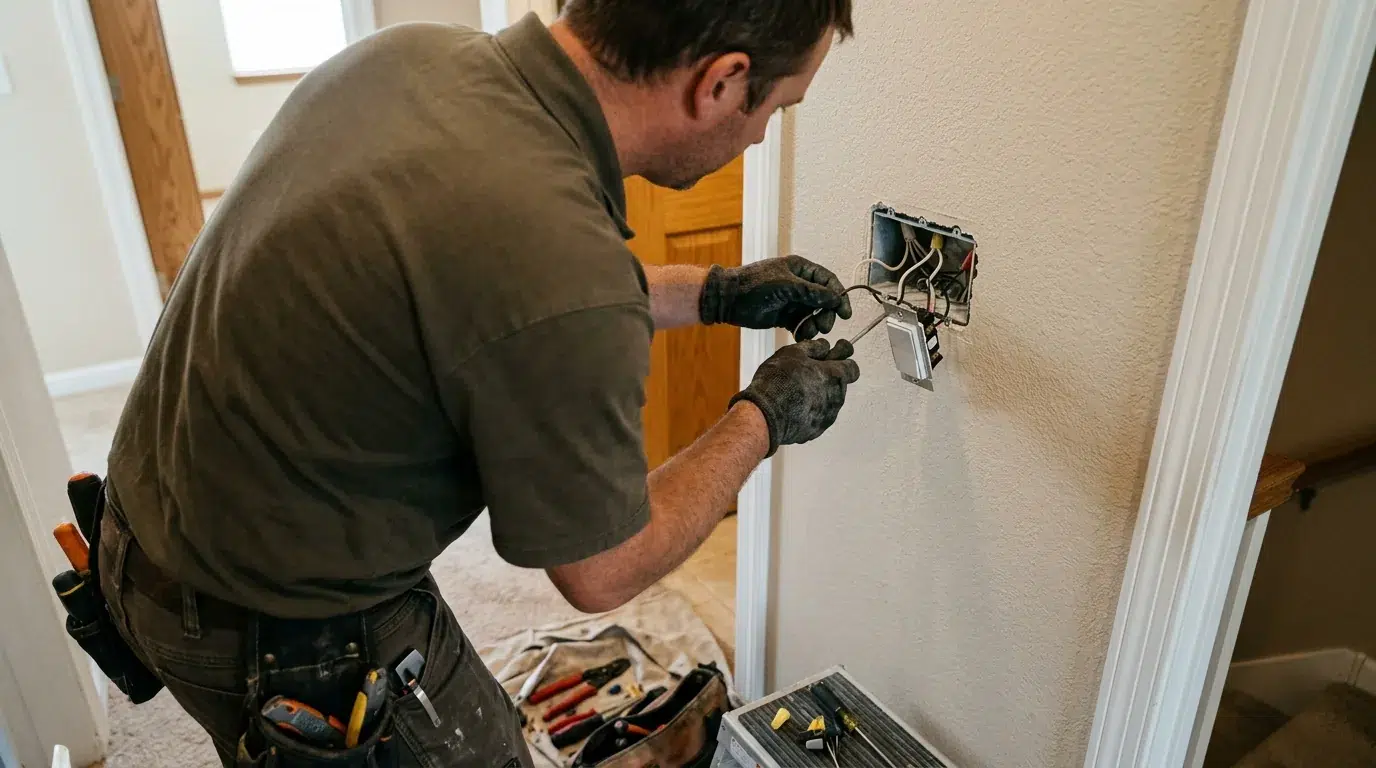
Whether the fan needs its own circuit depends on the unit and on what else shares the existing one — some manufacturers state their units do not require a dedicated circuit, and where the circuit has capacity and the instructions allow it, sharing is permitted. In practice most installs get a dedicated circuit sized to the unit, because sharing with attic lighting or a bedroom is what produces nuisance trips and visible dimming when the fan starts.
The control is part of the electrical work: a switch, a timer or a speed control matched to the unit, wired through the attic. A timer is what keeps the fan from running until morning after the house has already cooled.
Sizing, Noise and Honest Expectations
Sizing runs on house volume and the airflow the unit produces. Small units move roughly five air changes per hour in a typical house; large propeller fans run from ten to thirty. The arithmetic is CFM times 60 divided by house volume, with the target set by how the household uses the house.
Noise is a placement question as much as a model question. Insulated housings and vibration-isolated mounts make modern units quiet enough to hold a conversation under; older or badly mounted ones are not. A fan over a hallway is quieter in the bedrooms than one over a bedroom ceiling.
Permits and Licensing in Longmont
Where a new circuit is added, the work is permitted through City of Longmont Building Services at the Development Services Center, 385 Kimbark Street — 303-651-8332 — with applications and inspections through the Accela Citizen Access portal and inspection requests due by 4:00 p.m. the business day before.
The City requires a Longmont contractor licence under Municipal Code 16.48.030 and offers no reciprocity with other jurisdictions; electricians also hold a Colorado master licence and contractor licence.
What a Whole House Fan Costs
One published source frames this market, and it is quoted as theirs: Three Crowns Electric lists $1,500 to $3,500 for a QuietCool installation in Longmont. That is a contractor’s published range, not a quote for a specific house.
What moves a real quote: the unit and its airflow, whether a circuit is added, the control, attic access, and whether venting has to be corrected. A quote that assumes existing venting is adequate has an unstated condition in it.
Where a Fan Is the Wrong Purchase
No attic access, an attic with no room for additional venting, or a household that needs the house cool at a fixed temperature through the afternoon — in each of those cases the honest answer is that a fan will not do what the homeowner wants. We say so rather than sell one.
Related Work
The same scope is covered for Fort Collins and Loveland. If the circuit work turns out to be part of a bigger job, the Longmont panel replacement page covers capacity; our service area covers the rest of Northern Colorado. The Windsor scope is on the Windsor whole house fan page.
Frequently Asked Questions
How much attic venting does a whole house fan need?
About one square foot of net free vent area per 750 CFM — roughly four square feet for a 3,000 CFM fan. Existing vents are often sized for a much smaller job, and under-venting is what stops the fan working.
Does it need a dedicated circuit?
Not always. Some units are permitted to share a circuit where capacity allows, but most installs get a dedicated circuit because sharing produces nuisance trips and dimming when the fan starts.
Will it replace my air conditioner?
No. It replaces stored heat with cooler outside air when the outside air is cooler; it does not chill or dry the air. Many households use it at night and keep the air conditioner for the hot part of the day.
Can it go in a two-storey house?
Yes, usually in the upper hallway ceiling with the attic above. The venting requirement scales with the volume of air moved, so the attic check comes first either way.
Do I need a permit in Longmont?
A new fan installation can trigger more than one permit: electrical where a circuit is added, and building review where the ceiling or the attic venting is altered. City of Longmont Building Services confirms the scope for the specific job; a straight replacement on existing wiring is the narrower case.
How long does installation take?
Most installs finish in a day, circuit, control and speed testing included. Attic access and whether venting has to be added are what stretch it beyond that.

Request a Whole House Fan Quote in Longmont
Send a photo of the attic and the hallway ceiling, and we can tell you what the venting will support before anything is ordered. Precision Service Electric is family owned, in business 30 years, licensed and insured under Colorado license #3918, and rated 4.8 stars across 47 Google reviews. Call 970-593-3190 or request a quote.