

A whole house fan is sold as cooling and installed as an electrical job: a dedicated circuit, a control at the wall, wiring run through an attic that is usually 130 degrees in July, and a venting calculation that decides whether the fan moves air or just makes noise. Precision Service Electric installs whole house fans across Windsor and checks the attic before recommending one. Call 970-593-3190.
How a Whole House Fan Works
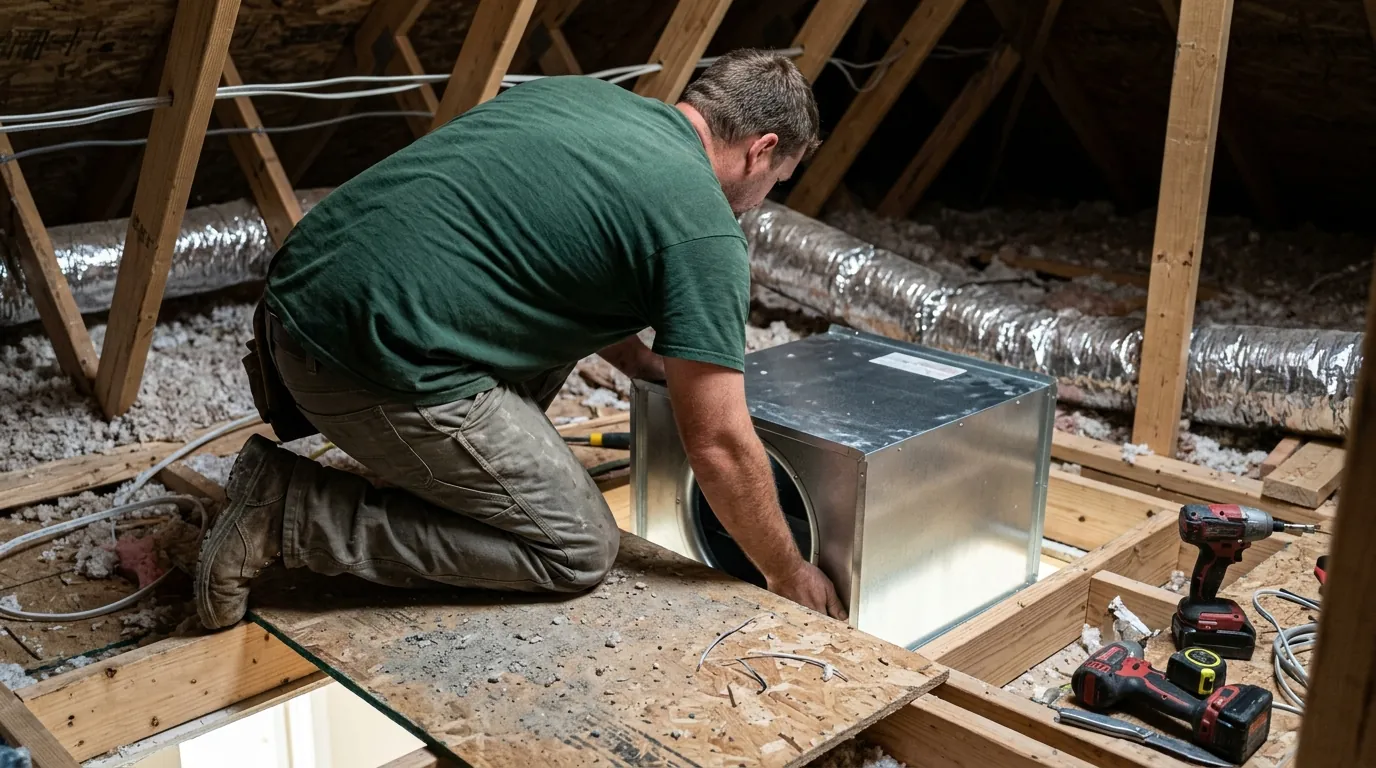
The fan sits in the ceiling between the living space and the attic, and pulls air out of the house into the attic, where it vents to the outside. Open a couple of windows on the cool side and the house draws that air in through them, replacing the hot air in one sweep.
It is not air conditioning. It does not cool the air and it does not dehumidify. What it does is replace the day’s stored heat with the evening’s cooler air, quickly, for a fraction of the electricity a compressor uses — and it works best in exactly the climate Windsor has: hot days, cool nights, low humidity.
The Electrical Scope
A Dedicated Circuit
A whole house fan is a motor load, and whether it needs its own circuit depends on the unit: some manufacturers state their models can share an existing circuit, while most installations are cleaner and more reliable on a dedicated one sized to the unit and protected at the panel. Sharing a circuit with the attic lighting or a bedroom is the shortcut that shows up later as a tripping breaker or a fan that dims the lights when it starts.
The Control
The control is electrical work, not an accessory: a switch, a timer or a speed control matched to the unit, wired through the attic to the fan. Two-speed and variable-speed models demand the control made for them, and a timer is what keeps the fan from running until dawn after the house has already cooled.
Wiring in the Attic
The run from the control to the fan is made in an environment that is hot, dusty and often tight. Cable has to be protected and supported, and the junction has to be accessible — which is why the fan’s location is decided with the wiring path in mind, not after the hole is cut.
Venting: The Part That Decides Whether It Works
A fan pushing air into an attic that cannot vent it builds pressure and stalls. The working rule is about one square foot of net free vent area per 750 CFM — roughly four square feet for a 3,000 CFM unit. Gable, ridge and soffit vents each count differently, and much of what is already on a Windsor roof was sized for a far smaller job.
Venting is measured before a model is chosen. Oversizing a fan in an under-vented attic makes the problem worse, not better.
Sizing the Fan
Sizing runs on volume and airflow. These fans move far more air than a ventilation unit — about 5 air changes per hour for a small one, 10 to 30 for a large propeller model — so the calculation is CFM times 60, divided by house volume, with the target taken from the manufacturer’s airflow and how the household lives. Footprint, ceiling height and the plan all feed it; a single-storey ranch and a two-storey with an open stair behave nothing alike.
When a fan is the wrong purchase — no attic access, or evenings that never cool — we say so instead of selling one.

Noise, Vibration and Where It Goes
The unit sits over a living space, so position matters as much as the model. Insulated housings and vibration-isolated mounts make modern units quiet enough to hold a conversation beneath; older or poorly mounted ones are not. Putting the fan over a hallway rather than a bedroom is usually the cheapest acoustic improvement available.
Installation, Step by Step
We inspect the attic first: the joist spacing, the venting, the wiring path and where the control will land. Then the ceiling opening is cut and framed, the fan is set and sealed, the dedicated circuit is run, the control is wired and the unit is tested at each speed. The attic is left with the wiring protected and supported, and the ceiling is left ready for paint.
.
Permits and Inspection in Windsor
The fan’s circuit is new electrical work, and new circuits are permitted in Windsor. The Town of Windsor issues the permit and inspections run through SAFEbuilt at 970-674-1036, against the 2024 I-Codes the Town adopted effective January 1, 2026.
Precision Service Electric is licensed and insured under Colorado licence #3918 and pulls the permit for the circuit.
What a Whole House Fan Costs in Windsor
Published numbers swing widely, which is why a range is more useful than one figure. Three Crowns Electric lists $1,500 to $3,500 for a typical QuietCool installation in Northern Colorado, with most jobs around $2,200 fully installed. The lower numbers that circulate in community threads generally describe a unit alone, or a straight replacement without a new circuit, control or venting correction — and none of them is attributable to a named installer.
What moves the price: fan size and type, the circuit, the control, attic access, whether venting has to be added, and whether the ceiling needs paint after the cut.
Serving Windsor and Northern Colorado
We install whole house fans throughout Windsor — Water Valley, Pelican Lakes, RainDance, Highpointe and the 80550 ZIP code — and across the communities we serve from our Loveland shop: Fort Collins, Loveland, Berthoud, Johnstown, Greeley, Longmont, Firestone, Timnath, Severance and Eaton. The full list is on our service area page.
For the same service north of us, see whole house fan installation in Fort Collins. If the fan is part of a bigger lighting or ceiling project, our lighting upgrades in Windsor page covers the circuit side.


“Excellent experience from start to finish. I will be utilizing PSE exclusively for my electrical needs moving forward. Thank you!”
Request a Whole House Fan Quote in Windsor
Send the square footage, whether the attic is accessible, and how the house cools today. We check the venting and the panel first, then tell you plainly whether a fan will deliver what you expect. Call 970-593-3190 or send us a message. Office hours are Monday through Friday, 7:00 AM to 4:00 PM.
Precision Service Electric is family owned, in business 30 years, licensed and insured under Colorado licence #3918, with a 4.8-star Google rating across 47 reviews.
Frequently Asked Questions
Does a whole house fan need its own circuit?
Not always. Some manufacturers state their units do not need a dedicated circuit, and where the existing circuit has capacity and the instructions permit it, the fan can share one. In practice most installs still get a dedicated circuit sized to the unit, because sharing with attic lighting or a bedroom is what produces nuisance trips and visible dimming when the fan spins up.
How much attic venting does a whole house fan need?
About one square foot of net free vent area per 750 CFM — roughly four square feet for a 3,000 CFM fan. Existing vents are commonly sized for a much smaller job, and under-venting is what stalls the fan.
How much does a whole house fan installation cost in Windsor?
Three Crowns Electric publishes $1,500 to $3,500 for a typical QuietCool install in Northern Colorado, most around $2,200 installed. Figures below that range usually describe a unit price or a swap with no new circuit and no control, and they cannot be attributed to a named installer.
Do I need a permit for a whole house fan in Windsor?
For the new circuit, yes — the Town of Windsor issues the electrical permit and inspections run through SAFEbuilt at 970-674-1036, against the 2024 I-Codes adopted effective January 1, 2026.
Can a whole house fan replace air conditioning?
Not during Windsor’s hottest weeks, and not on evenings when the outside air stays warm. The fan swaps the day’s stored heat for cooler evening air very efficiently; it does not chill the air or take humidity out of it. Many households run it instead of the AC at night and keep the AC for the peaks.
How noisy is it?
Modern units with insulated housings and vibration-isolated mounts can be talked over. Position decides most of it — a fan over the hall is quieter in the bedrooms than one over a bedroom ceiling.
How long does the installation take?
One day covers most jobs — circuit, control and a test at each fan speed. What pushes past that is attic access, or finding that venting has to be added while the attic is open.