

Finishing a basement is an electrical project wearing a construction hat. Before the drywall goes up, the circuits have to be planned: outlets every few feet along the finished walls, AFCI protection, a dedicated circuit for a bathroom or a kitchenette, smoke and CO interconnection, recessed lighting, and usually a subpanel so the new space does not lean on a panel that is already full. Precision Service Electric wires basement finishes across Windsor and works to the framing schedule so the trades behind us are never waiting. Call 970-593-3190.
What the Electrical Scope Covers
A basement finish typically includes: a panel or subpanel evaluation, new circuits for the finished rooms, receptacle layout on the new walls, lighting for every finished space including storage and stairs, switching at the entrances, smoke and carbon-monoxide interconnection, and provisions for whatever the plan puts down there — a bathroom, a kitchenette, a home theater, a gym, an office.
Every one of those decisions becomes demolition once the walls close, so the layout is fixed while the framing is still open.
The Sequence: Rough-In, Inspection, Drywall, Trim
Rough-In
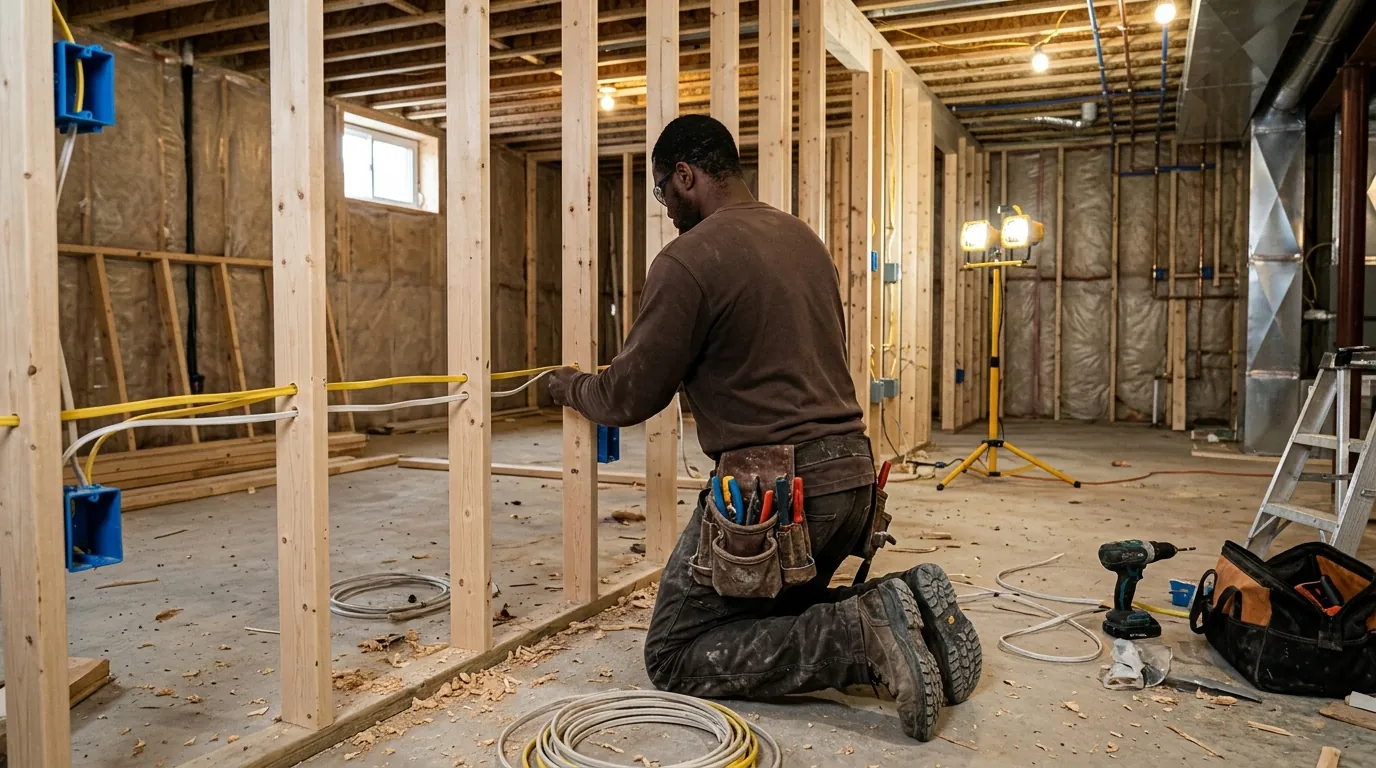
Rough-in happens with the framing open and before insulation and drywall: boxes set at the right heights, cable run and protected, holes drilled through studs at the correct depth, and the panel work done or planned.
Rough-In Inspection
The rough-in is inspected before the walls close. This is the step that catches a missing AFCI, a box set too deep, or a cable run that would have been buried without protection — and it is the reason the sequence cannot be compressed to save a week.
Trim-Out
After drywall and paint, devices go in: receptacles, switches, fixtures, covers, and the final connections. Then the final inspection, then power.
Circuits a Basement Actually Needs
General-purpose circuits for the finished rooms, a dedicated circuit for a bathroom, at least two 20-amp small-appliance circuits where a kitchenette qualifies as a kitchen (one dedicated circuit is enough for a wet bar), a dedicated circuit for laundry equipment if there is any, and separate circuits for any large load — a treadmill, a workshop tool, a home theater amplifier. Bedrooms require AFCI protection, bathrooms and kitchenette counters require GFCI protection, and a basement bedroom needs its own smoke alarm interconnected with the rest of the house.
The count is not guesswork: it follows from the plan and from what the homeowner intends to plug in.
Subpanel or Not?
A basement subpanel is frequently the least disruptive way to gain eight or ten circuits without reworking the main panel — provided the main service has room to feed it. When the service is already at its ceiling, a subpanel relocates the constraint rather than removing it, and the load calculation is the conversation to have before framing.
Our panel replacement in Windsor page covers the capacity side in detail.
Lighting a Basement Properly
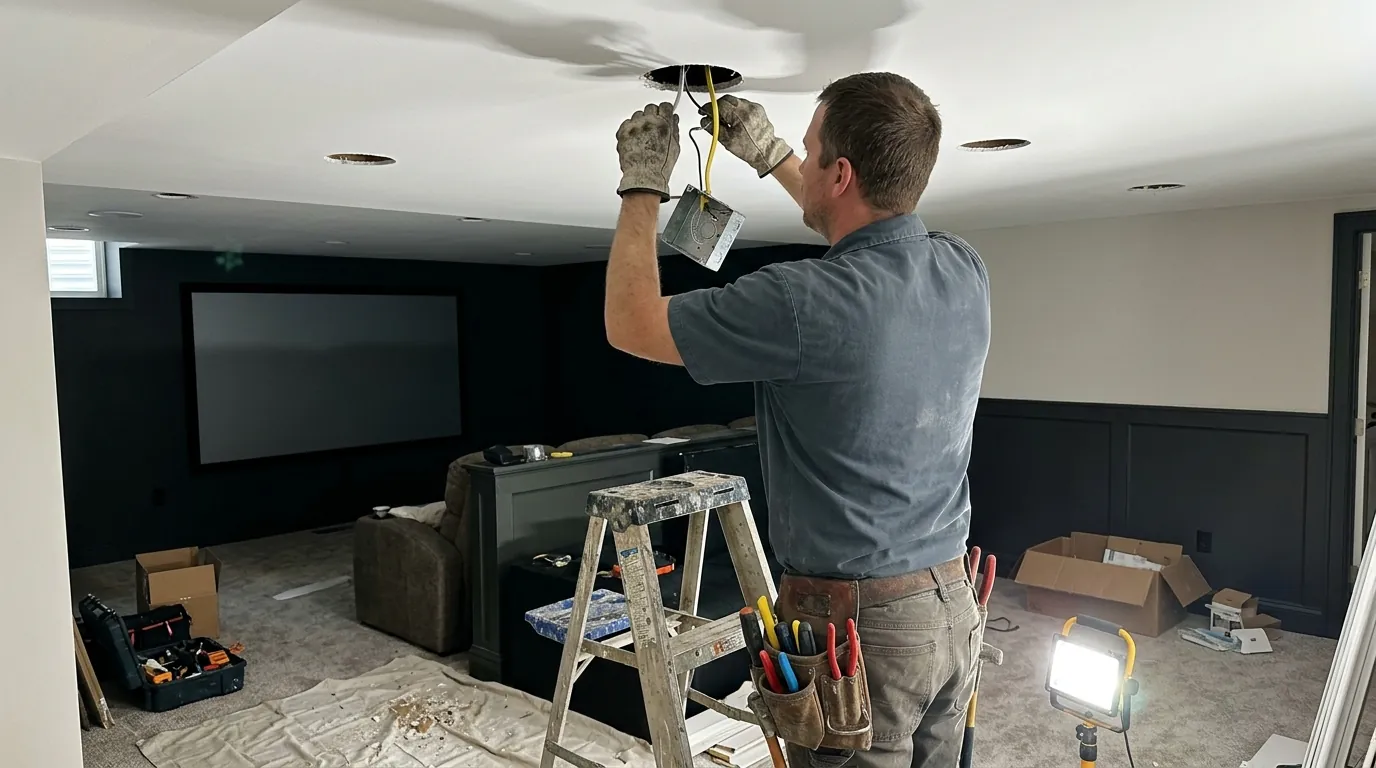
Low ceilings and no daylight make lighting the decision basement owners regret most. Fixtures sized and spaced for the actual ceiling, zones on separate switches, and deliberate light in storage areas and at the stairwell — the places where one bare bulb turns into a hazard.
Dimming earns its keep down here: the same family room reads completely differently at 30 percent than at full. Fixture and dimmer compatibility is confirmed before anything is purchased. The detail lives in our Windsor lighting guide.
Permits and Inspection in Windsor
A basement finish is permitted work: the Town of Windsor issues the building and electrical permits, and inspections run through SAFEbuilt at 970-674-1036. The Town adopted the 2024 I-Codes effective January 1, 2026, which sets the building-side requirements for current work. The AFCI and GFCI rules come from the NEC edition the Town enforces, and the smoke/CO interconnection rules from the residential code; the permit office confirms both when the permit is issued.
Licensed and insured under Colorado licence #3918, and we pull the electrical permit for the scope we perform, with the rough-in and final inspections scheduled into the job.
Working With Your Builder
A basement finish runs on a schedule, and the electrical rough-in sits in the middle of it: framing, then electrical and plumbing rough-in, then inspection, then insulation, drywall, paint, trim. If the electrician arrives after the insulation, the schedule slips.
We build around the builder’s sequence, book the inspection date, and return for trim after paint. Coordinating those handoffs is what keeps a basement on schedule rather than stalling between trades.
What Basement Electrical Work Costs in Windsor
The electrical portion of a basement finish is driven by the number of circuits, the number of openings, the lighting plan, whether a subpanel or service upgrade is needed, and whether the ceiling is open or the layout changes mid-build.
Fixed-plan basements cost less per square foot than ones that keep moving, because every relocated box means a patch and another look from the inspector. The estimate comes off the plan, not off the floor area.
Serving Windsor and Northern Colorado
We wire basement finishes throughout Windsor — Water Valley, Pelican Lakes, RainDance, Highpointe and the 80550 ZIP code — and across the communities we serve from our Loveland shop: Fort Collins, Loveland, Berthoud, Johnstown, Greeley, Longmont, Firestone, Timnath, Severance and Eaton. The full list is on our service area page.
For the same scope north of us, see basement electrical finishes in Fort Collins.


“These guys ran a couple of 240 lines for a hot tub and some kitchen equipment, they did great work. Clean, tidy, solid components. We will use them again 100% Corey was easy to work with and right on schedule.”
Request a Basement Electrical Quote in Windsor
Send the plan, even a sketch, plus a sentence on how the space will be used. Rough-in and trim are priced separately so the builder can slot them into the schedule. Call 970-593-3190 or send us a message. Office hours are Monday through Friday, 7:00 AM to 4:00 PM.
Precision Service Electric is family owned, in business 30 years, licensed and insured under Colorado licence #3918, with a 4.8-star Google rating across 47 reviews.
Frequently Asked Questions
When should the electrician start on a basement finish?
After the framing is up and before insulation and drywall. The rough-in is inspected before the walls close, so the electrical work has to be sequenced between framing and insulation — not squeezed in afterwards.
Do basement outlets need special protection?
Finished basement circuits generally require AFCI protection, and basement receptacles generally require GFCI protection — not only bathrooms and kitchenette counters, with the specific exceptions the code allows. The requirements follow the code edition the Town enforces, which the permit office confirms when the permit is issued.
Do I need a separate panel for a finished basement?
Usually, and it is often the practical route — as long as the main panel can feed it. Where the service is already maxed out, a subpanel simply relocates the bottleneck and a service upgrade becomes the honest recommendation.
Do I need a permit for basement electrical work in Windsor?
Yes. A basement finish is permitted work: the Town of Windsor issues the permits and inspections run through SAFEbuilt at 970-674-1036, with a rough-in inspection before drywall and a final inspection at trim.
Can I add a bathroom in the basement?
Yes, with a dedicated circuit, GFCI protection at the counter and bath locations, and an exhaust fan vented to the exterior. The plumbing rough-in and the electrical rough-in are inspected together.
How long does the electrical work take?
Rough-in generally takes a few days on a full basement; trim runs a day or two once paint is done. Elapsed time is governed by the construction schedule rather than by the electrical work on its own.
Can you work with my contractor?
Yes, that is the standard arrangement. We follow the builder’s sequence and coordinate inspection dates, which is most of what keeps a basement project on its timeline.