

A whole house fan is a ventilation machine sold as a cooling machine, and the difference shows up on the second hot night. The fan moves house air into the attic; whether it works depends on the attic being able to let that air out, and on the windows being open enough to let outside air in. Precision Service Electric installs whole house fans in Wellington and checks the attic before quoting a unit. Call 970-593-3190.
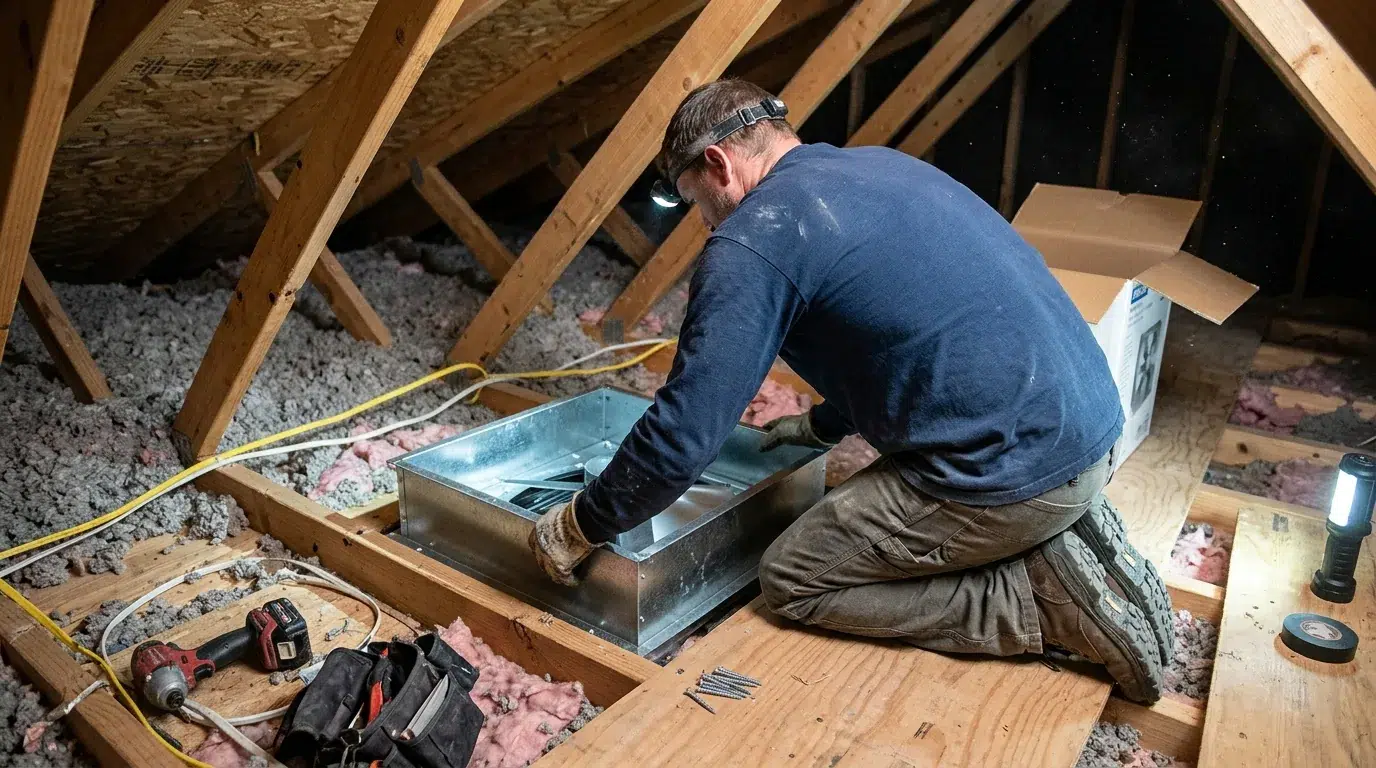
How a Whole House Fan Actually Cools a Wellington Home
The fan sits in the ceiling, usually over a hallway, and exhausts house air into the attic, where it escapes through the attic vents. Open downstairs windows and cooler evening air is drawn through the rooms on its way out. Nothing is refrigerated: the building is flushed with outside air.
That is why the system suits this part of Colorado so well — low humidity and a large overnight temperature drop do most of the work — and why it does nothing at four in the afternoon. It is an evening and shoulder-season device, and wildfire-smoke days are the obvious reason not to run it.
It also explains the rule people get wrong. With the windows shut the fan still moves air, but it pulls it through leaks and other openings instead of through the rooms — depressurising the house and potentially drawing combustion gases indoors. Open enough windows first, fan on second, and have combustion appliances and any fireplace evaluated for backdrafting under operating conditions before the fan is commissioned — depressurisation is exactly the condition that can pull flue gases the wrong way.
Whole House Fan vs Attic Fan vs Air Conditioning
An attic fan stirs the attic alone: it lowers the temperature up there and never touches the rooms below. A whole house fan takes the rooms themselves and pushes that air through the attic and out. Air conditioning does neither — it removes heat from the interior air and could not care less whether a window is open, which is why the three get confused in showrooms and almost never in a house.
Most Wellington households that install a whole house fan keep the air conditioning. The fan reduces how often it runs in the evening and overnight, which is where the bill was coming from anyway.
Attic Venting: The Check That Decides Everything
A fan rated at 3,000 CFM moves that volume only if the attic can get rid of it. The preliminary guideline used across the industry is one square foot of net free vent area per 750 CFM of fan rating, and net free area is not the size of the vent opening — each vent has a manufacturer rating, and that rating is what counts.
Treat the 750 figure as a starting point: the installation instructions that ship with the unit govern, and the code does not contain this number at all. Where soffit vents are buried under insulation, where the roof or gable vents are too small, or where a ridge vent has no intake to feed it, the attic cannot relieve the airflow and the pressure finds the weakest path — often the joints in the ceiling below.
Venting varies by attic, and Wellington has both kinds — established in-town houses with older roof assemblies and newer subdivision builds with ridge-and-soffit systems sized for passive performance. We measure the relief area and look at whether the soffit path is open before selecting a fan.
The Electrical Side: Circuit, Switch, and Code
Whether a dedicated circuit is needed, and what size it has to be, depends on the fan’s electrical rating, its installation instructions, the calculated load and the applicable code. A small direct-drive unit and a larger two-speed unit do not land in the same place, and the nameplate decides rather than habit.
Where the code calls for a disconnecting means within sight, that is part of the scope, and the control run for a two-speed or timer setup is wiring rather than an add-on. This is the point where a fan installation becomes an electrical project — and if the panel is full, the circuit question becomes a panel question.
Permits in Wellington
Applications go through the Town of Wellington Building Department at 8225 Third Street, 970-821-5078, using Community Core; plan review, permitting and inspection are handled by SAFEbuilt’s Windsor branch on the Town’s behalf, 970-674-1036. Electrical-only work sits in the Town’s one-stop categories, which is what a new fan circuit is; a change to the ceiling or the venting can bring building review alongside.
Any contractor working in Wellington needs a current Town of Wellington contractor licence first. The Town adopted the 2024 I-Codes effective 1 January 2026 and states alignment with the current National Electrical Code.
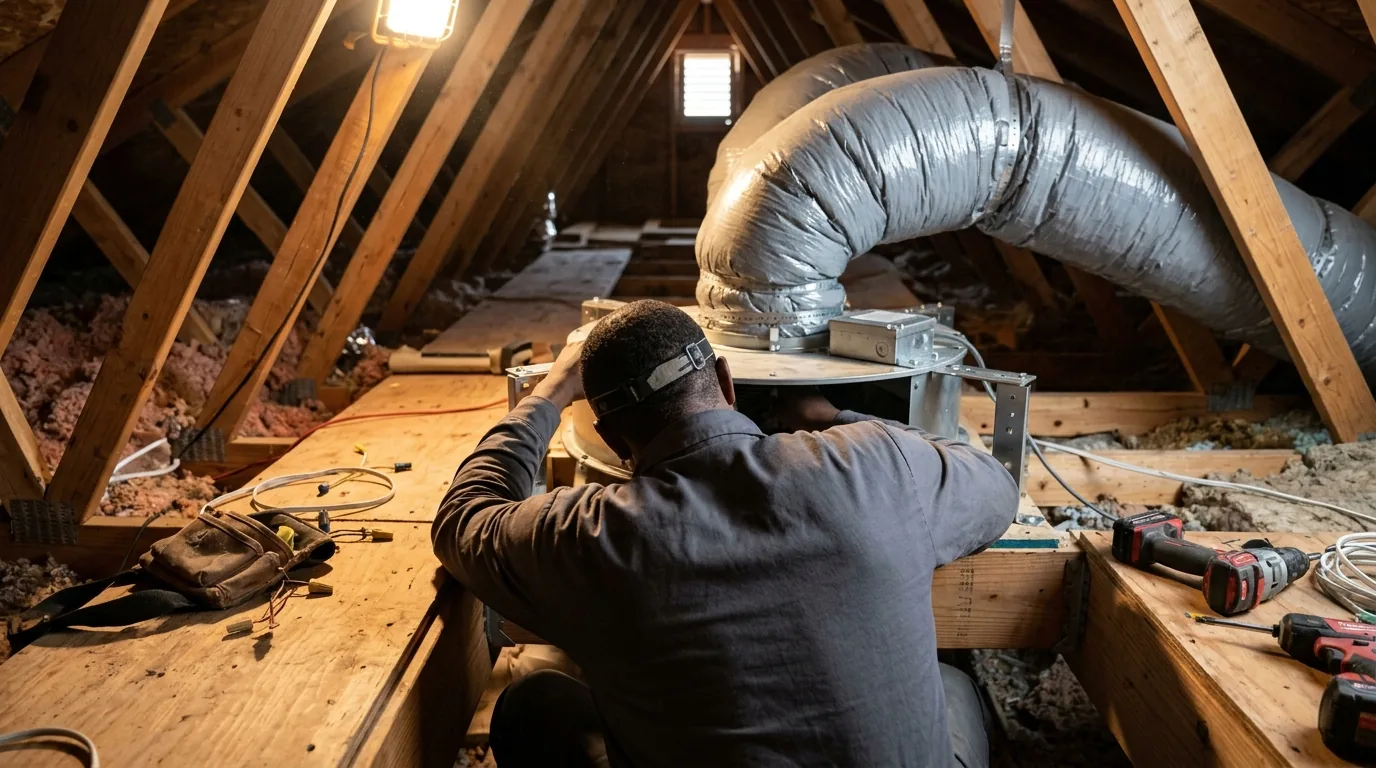
Our Process, Step by Step
We start in the attic, because that is where the answer lives: measure the relief area, look at the soffit path, and see whether the framing will take the unit where it needs to sit. Then comes the circuit plan and a written scope, the permit, the ceiling opening with its damper and sealing detail, the control run, a live test with windows open, and the inspection.
We quote the fan, the venting work and the electrical as separate lines, because they are separate decisions and because the venting determines whether the machine performs.
Whole House Fan Installation Cost in Wellington
No Wellington-specific survey is published. The nearest attributable figures are Three Crowns Electric’s Northern Colorado numbers: $1,500 to $3,500 installed with a median near $2,200, and a venting-upgrade tier at $2,500 to $3,500. Those are that company’s published figures, not our price list.
What moves the number here: unit tier and airflow, whether the attic needs additional relief venting, the circuit and its distance from the panel, the control package, and ceiling access. Labour concentrates wherever the attic stops being convenient: a vaulted ceiling over the hallway costs more than a walkable attic above a flat ceiling, and the quote reflects the access rather than the fan.
Is a Whole House Fan Worth It in Wellington?
The house decides, not the postcode. Cross-ventilation — windows on two sides — is what makes the flush work, so a two-storey with an open stairwell and windows front and back performs far better than a plan with one window per room. Households that are actually home in the evening collect the benefit; allergy sufferers and anyone living through a smoke-heavy August collect rather less.
The honest framing: it is the cheapest way to make summer evenings comfortable in a house with decent windows and a vented attic, and it is a poor substitute for air conditioning in a house without either.
Service Area: Wellington and Northern Colorado
We work Wellington and the corridor around it — Fort Collins, Timnath, Windsor, Severance and Ault. The permitting authority and the utility change at the town line, which is why this page’s local detail is Wellington’s.
Request a Whole House Fan Quote in Wellington
A photo of the attic from the hatch and one of the open panel tells us most of what we need. Precision Service Electric is family owned, in business 30 years, licensed and insured under Colorado license #3918, factory-trained and an authorized Generac dealer, and rated 4.8 stars across 47 Google reviews. Call 970-593-3190 or request a quote.
Related Work in Wellington
The circuit starts at the panel — see panel replacement in Wellington if the spaces are gone. For another town’s version of this job, read the Loveland whole house fan page or the Longmont page, or start from our service area.


“Precision was prompt, the electrician was very knowledgeable, and the prices were great! They helped install new lights and ceiling fans. Highly recommend them to everyone!”
Frequently Asked Questions
Do I need a permit for a whole house fan in Wellington?
A permit is generally required when the installation includes a new electrical circuit, and electrical-only work is in the Town’s one-stop categories. We confirm the requirements for the specific installation with the Building Department.
Does a whole house fan replace air conditioning?
No. It covers the evening and overnight window and is irrelevant at four in the afternoon in July. Households here generally run the air conditioning less often once a fan is in, rather than retiring it.
Why do the windows have to be open?
The fan exhausts air into the attic and out the vents, so it needs a path for outside air to enter. Without open windows the house depressurises and the fan moves far less air.
My attic only has a ridge vent — is that enough?
Often not. The attic needs relief area as well as an exhaust path, and the preliminary guideline is one square foot of net free vent area per 750 CFM, measured by each vent’s rated net free area.
Is there a rebate for a whole house fan in Wellington?
Poudre Valley REA publishes a residential rebate catalogue covering appliances, EV chargers, heating and cooling and outdoor equipment. We are not aware of a whole house fan rebate, and we would rather say that than imply one.
How loud is it?
Entirely by unit. Airflow ratings say nothing about noise, two models can sit ten decibels apart, and an insulated ducted fan is noticeably quieter than a direct-drive box. Ask for the sound rating, not just the CFM.