

The lighting aisle is where this decision usually starts, and it is the wrong end of it. Longmont has lighting showrooms on Ken Pratt and Virginia Avenue, and they will sell you a fixture without knowing whether your ceiling can take it, whether the switch box has a neutral for the dimmer, or whether the circuit feeding the room has room for nine more heads. The wiring decides those, and it is settled before anything is bought. Precision Service Electric installs recessed lighting, under-cabinet lighting, ceiling fans and exterior lighting in Longmont. Call 970-593-3190.
Start With the Room, Not the Fixture
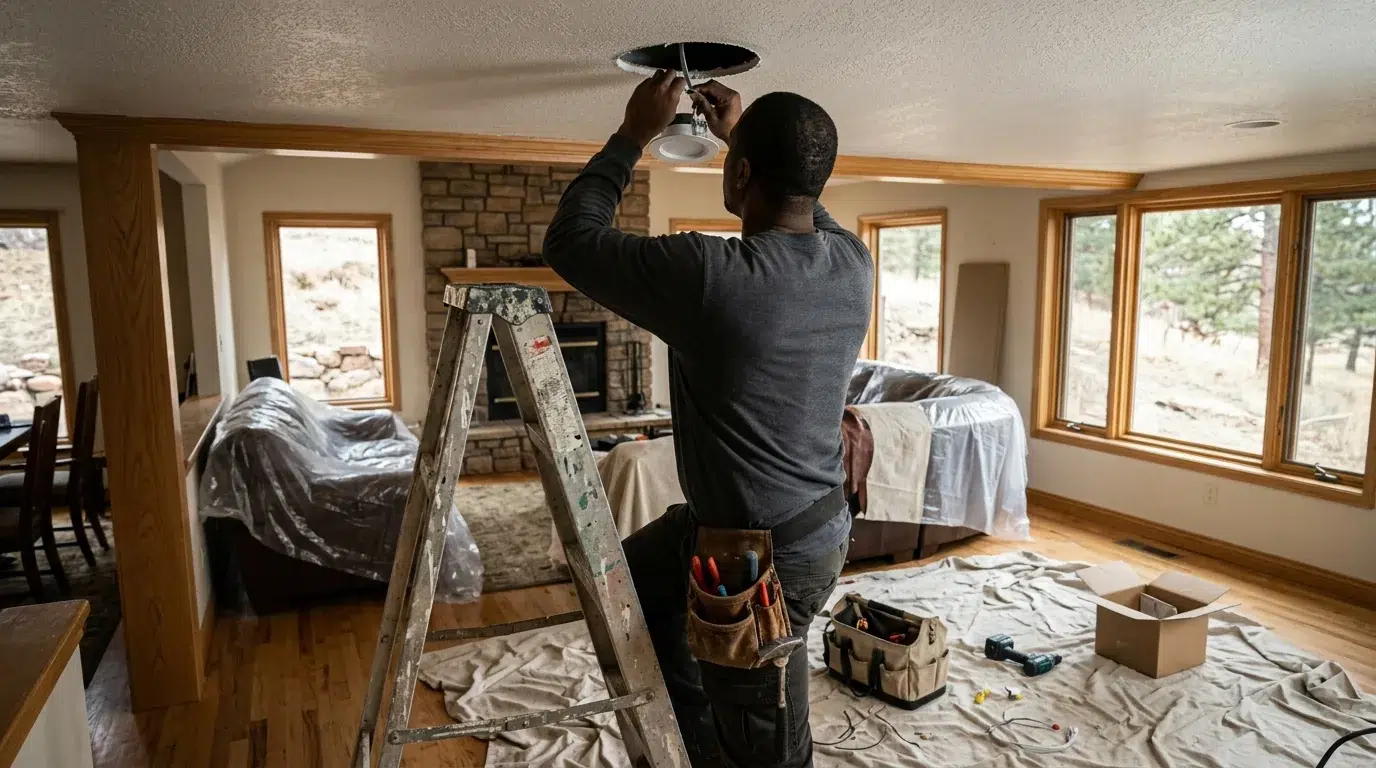
Two questions decide the layout before a product exists. What happens in this room — cooking, reading, watching, working at a desk? And what sits above the ceiling: attic, insulation, a floor, ductwork? The first sets where light has to land; the second sets what housing can legally go in.
Longmont’s older houses near downtown often answer the second question awkwardly: a finished ceiling with a shallow cavity, or a plaster ceiling that has been patched more than once. Newer subdivisions usually have open attic above the main rooms, which makes the install simpler and the housing choice wider.
Recessed Lighting: The Decisions That Matter
Spacing Follows the Work Surface
A first estimate is half the ceiling height between fixtures, then corrected with the fixture’s own spacing criteria and by keeping glare out of the place people actually sit or stand. Kitchens get light on counters and islands; living rooms get wall-washing rather than a row of bright points over the sofa.
Housing: IC, Air-Tight, and What the Ceiling Requires
In an insulated ceiling, new recessed luminaires should be rated for insulation contact. Where the energy-code requirements apply to the thermal envelope, they also need to be air-tight and sealed to the ceiling — which is both a code point and the reason rooms above garages feel cold. Outside those envelope requirements a non-IC fixture is permitted with the clearances its listing specifies.
Retrofit or New Construction
A retrofit housing goes in through a cut opening from below, leaving the ceiling otherwise intact. New-construction housings need the ceiling open and give more freedom in size, trim and insulation detail. A basement or remodel that is already open uses the second; a single-room upgrade in a finished ceiling usually uses the first.
Dimmers and the LED Compatibility Problem
Almost every lighting complaint we are called about is a dimmer issue, not a fixture issue: flicker at low levels, a buzz, a dimming range that stops at 60 percent, or a fixture that glows when switched off. LEDs draw far less current than the dimmers designed for incandescent loads expect.
The fix is compatibility checked before purchase — the dimmer’s published LED list, the fixture’s driver requirements, and enough load on the circuit for the dimmer to behave. In older Longmont houses the switch box may not have a neutral, which rules out some smart dimmers entirely.
Under-Cabinet, Ceiling Fans and Exterior Lighting
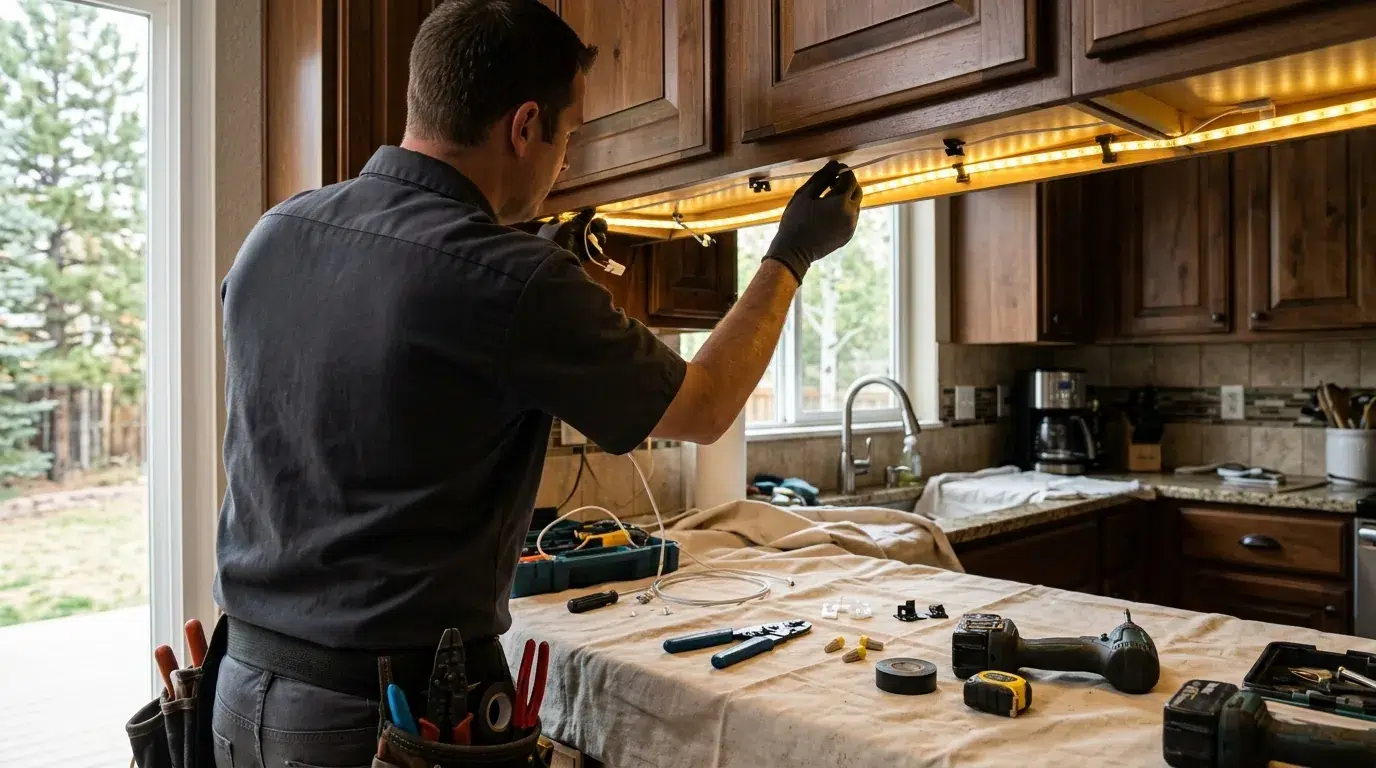
Under-cabinet lighting is a task-light job with a wiring problem attached: the driver has to live somewhere reachable, the run has to be protected, and the switching has to be separate from the ceiling so the kitchen can be lit for cooking rather than for cleaning.
Ceiling fans need approved support — a listed fan-support box or system, or independent structural support installed to the manufacturer’s instructions — and a control that matches how the fan is wired. In older homes it is common to find a fan hanging from a box installed for a light fixture; that is a safety problem, not a style one.
Exterior and security lighting brings its own rules: fixtures rated for wet and damp locations, ground-fault protection where it applies, and a switch position that does not leave anyone crossing a dark yard to find it.
Permits: What Needs One and What Does Not
A like-for-like fixture swap on an existing circuit generally does not require a permit. Adding circuits, moving fixtures to new locations and extending wiring do. City of Longmont Building Services handles the electrical permit at the Development Services Center, 385 Kimbark Street — 303-651-8332 — with applications and inspections through the Accela portal and inspection requests due by 4:00 p.m. the business day before.
Licensing is separate from permitting and worth checking: the City requires a Longmont contractor licence, offers no reciprocity with other jurisdictions, and requires electricians to hold a Colorado master licence and contractor licence.
What Lighting Work Costs in Longmont
Per-fixture prices published by contractors working this corridor are the only ones worth reading, and they are quoted as theirs. Three Crowns Electric lists lighting installation from $200. MSI Mechanical lists retrofit recessed lighting in existing finished ceilings at roughly $150 to $300 per can installed, plus the fixture.
Those numbers describe a fixture going into a ceiling that is ready for it. What moves a real project: how many heads, whether circuits are added, whether the ceiling is insulated and needs IC-rated housings, whether the panel has spare capacity, and how much patching and painting the layout requires.
Our Process
Walkthrough first — room, ceiling, switching, circuit — then a layout marked on the ceiling before anything is ordered. One written quote covers fixtures, housings, dimmers, circuit work, patching expectations and the permit line. Install follows, and where circuits are added the work is inspected.
Related Lighting Work
The same approach is covered for Fort Collins and Windsor. Where the constraint turns out to be the panel rather than the fixtures, the answer is on the Longmont panel replacement page. Our service area covers the rest of Northern Colorado. The same approach in Loveland is on the Loveland lighting page, and panel capacity is covered by panel replacement in Loveland.
Frequently Asked Questions
How many recessed lights does a room need?
There is no fixed number. Ceiling height, the room’s use and the surfaces that need light decide it; the usual first estimate is half the ceiling height between fixtures, refined with the fixture’s spacing criteria and by keeping glare away from where people sit.
Do I need IC-rated housings in Longmont?
Where the energy-code requirements apply to the thermal envelope, yes — IC-rated, air-tight and sealed to the ceiling. Outside those requirements a non-IC fixture is permitted with the clearances its listing specifies.
Why do my LED lights flicker on a dimmer?
Usually a mismatch rather than a fault — an older dimmer whose minimum load the LEDs never reach, or a driver that is not on its compatibility list. Matching the dimmer to the fixture is the fix.
Do I need a permit to add recessed lighting?
If the work adds circuits, relocates fixtures or extends wiring, yes — through City of Longmont Building Services. A straight fixture swap on existing wiring generally does not.
Can under-cabinet lighting be added without cutting the wall?
Often, yes: supply can frequently be taken from an existing circuit above or below the cabinets. In older kitchens it depends on what is already inside the wall, which is why the walkthrough comes first.
Do you install ceiling fans as well?
Yes — with approved fan support and a control matched to the fan, which is the part that fails when a fan is hung from a box meant for a light fixture.


“Prompt, friendly service! Very reasonable pricing and great work!”
Request a Lighting Quote in Longmont
Send a photo of the room and the ceiling, and the layout conversation starts with something concrete. Precision Service Electric is family owned, in business 30 years, licensed and insured under Colorado license #3918, and rated 4.8 stars across 47 Google reviews. Call 970-593-3190 or request a quote.