

A lighting upgrade looks like a shopping decision and is really an electrical one: how many fixtures a circuit can carry, whether the ceiling can take a can light, whether the switch box has a neutral for a dimmer, and what is above the drywall. Precision Service Electric installs recessed lighting, under-cabinet lighting, ceiling fans and exterior lighting across Erie, and works out the circuit before anyone cuts a hole. Call 970-593-3190.
What a Lighting Upgrade Actually Changes
Most homes are lit with one fixture in the middle of the ceiling, sized for the room’s footprint rather than for what happens in it. A real upgrade replaces that single source with layers: general light, task light where the work happens, and accent light that gives a room depth.
The electrical part is what makes the layers possible — separate switching, dimming, and enough circuits to carry the added load. A room with eight recessed heads on one switch is not a lighting design; it is a brighter version of the same problem.
Recessed Lighting: Layout Before Hardware
Spacing and Placement
Recessed cans are placed by the ceiling plane and the task below, not by an even grid. A kitchen wants light on the counters and the island, not behind the person standing at them. A living room wants wall-washing and a dark ceiling corner, not eight points of glare over the sofa.
Spacing rule of thumb: a common preliminary estimate is half the ceiling height between fixtures, then adjusted using the fixture’s own spacing criteria and the task below. That is a starting point for the layout conversation, not the answer.
Insulation-Contact, Air-Tight Ratings and Sealing
In an insulated ceiling — most of an Erie house, upstairs and over a garage — new recessed luminaires should be rated for insulation contact (IC) and, where the energy-code requirements apply to the thermal envelope, rated air-tight and sealed to the ceiling. Outside those envelope requirements a non-IC fixture is permitted with the clearances its listing requires, which is a detail to settle before the ceiling is opened.
The wrong fixture in the wrong ceiling is a fire and moisture problem, and it is invisible once the drywall is patched.
New Construction vs. Remodel Housings
A ceiling with attic access above it takes a different housing from one with a finished floor above it. Remodel housings install from below through a cut hole; new-construction housings need the ceiling open. Knowing which applies is the difference between a clean installation and a patch job.
Controls: The Part People Forget
Dimmers have a minimum load and a compatibility list; LED fixtures that buzz or flicker on an old dimmer are usually a compatibility problem, not a defective fixture. Three-way and four-way switching lets a room be entered from more than one point — a hallway, a stair, a kitchen with two openings.
Smart switches need a neutral at the box in most cases, and older switch loops may not have one. That is checked before the switch is bought, not after.
Load and Circuits
Lighting is a small load compared with heating or an EV charger, but the count matters when a room goes from one fixture to ten. A typical 15-amp lighting circuit carries far more than a bedroom’s worth of LED cans; the constraint is more often switching, box fill and the number of home runs than raw amperage.
Where a basement or an addition is involved, the lighting is part of a larger circuit plan — and where the panel is full, the panel becomes the first conversation. That work is covered on our panel replacement in Erie page.

Under-Cabinet, Ceiling Fans and Exterior Lighting
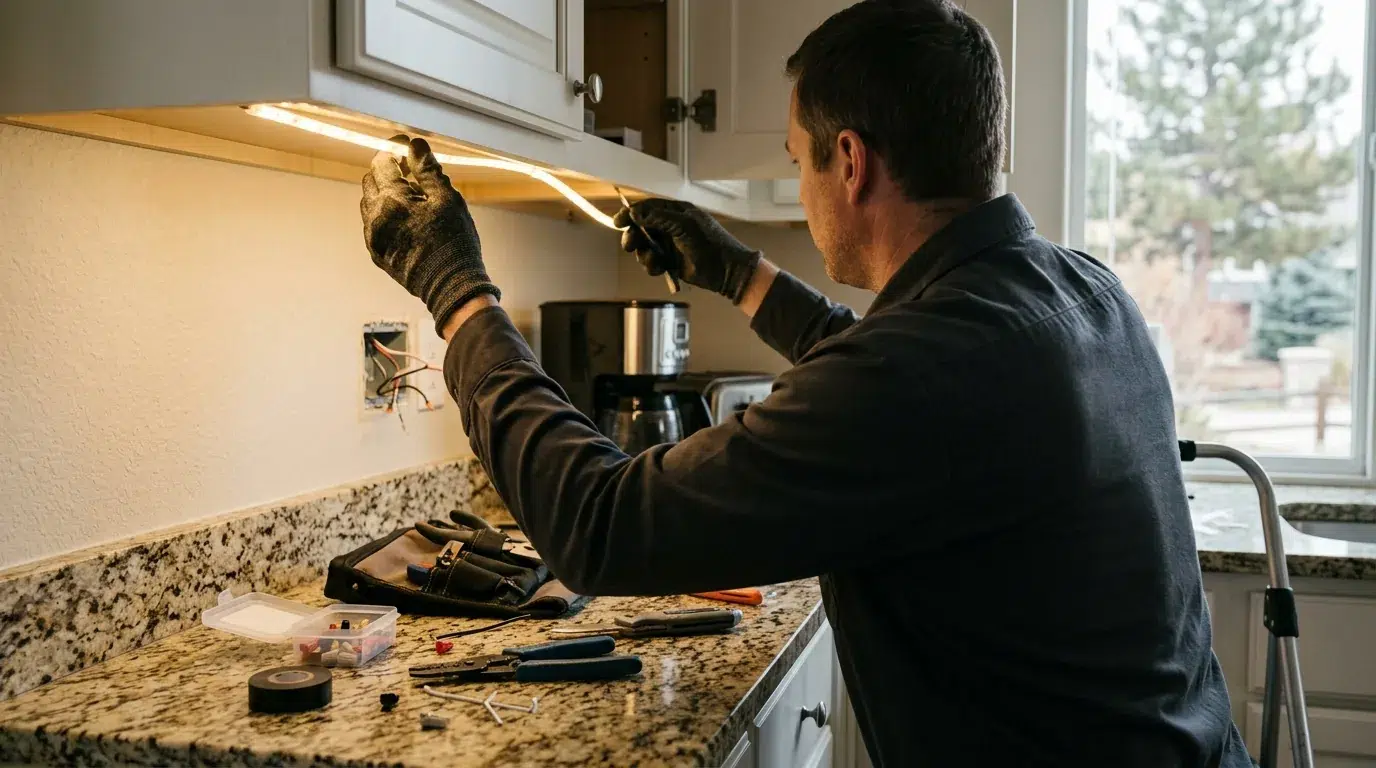
Under-cabinet lighting is a wiring job as much as a lighting one: the driver has to live somewhere accessible, the run has to be protected, and the switch has to be where a person actually reaches it. Ceiling fans need a fan-rated box anchored to structure, not a standard ceiling box, and a control that matches the fan’s wiring.
Exterior and security lighting has its own requirements: weather-rated fixtures, GFCI protection where the code requires it, and a switching arrangement that does not leave the homeowner walking into a dark yard.
Permits and Inspection in Erie
Adding circuits, running new home runs or installing exterior lighting is permitted electrical work in Erie. The Town of Erie Building Division, 645 Holbrook Street, issues the electrical permit — 303-926-2700, with applications and inspections through the Town’s eTRAKiT portal.
Whether a particular job needs a permit depends on scope: new circuits and new wiring do, and a straight like-for-like fixture swap on an existing circuit often does not. That boundary is confirmed with the Town when the scope is set rather than assumed in either direction.
Precision Service Electric is licensed and insured under Colorado licence #3918 and pulls the permit when the scope requires one.
What the Work Involves
We start with the room, the ceiling and the switch locations, then confirm what is above the ceiling and what the existing circuit can carry. The layout is marked before anything is cut. Wiring is run and protected, boxes are set, fixtures are installed, controls are wired and tested, and the drywall is left ready for finishing.
Most single-room installations are a one-day job; a whole-house upgrade or a basement is scheduled in stages so the house stays usable.
What a Lighting Upgrade Costs in Erie
Price is driven by access and count, not by the fixture’s sticker. Ceiling height, attic access, insulation, whether the ceiling is finished, how many fixtures, how many switches and whether new circuits are needed all move the number.
The one local published anchor is Three Crowns Electric’s Northern Colorado lighting page, which lists work from $200 per fixture. That is their figure, it describes their scope, and it is useful mainly as a sanity check on a per-fixture quote rather than as a budget for a whole room. We price after the walkthrough, with the fixture count and the circuit work both visible.
Serving Erie and Northern Colorado
We install lighting throughout Erie — Old Town, Vista Ridge, Kenosha Farm, Erie Village, Coal Creek and the 80516 ZIP code — and across the communities we serve from our Loveland shop: Fort Collins, Loveland, Windsor, Berthoud, Johnstown, Greeley, Longmont, Firestone, Timnath, Severance and Eaton. The full list is on our service area page.
For the same service elsewhere, see lighting upgrades in Fort Collins and Windsor.


“Finally an honest electrical company! Knowledgeable and fair pricing. Highly recommended! I used them for an old commercial building and they did not try to upsell me.”
Request a Lighting Quote in Erie
Tell us which rooms and what you want the light to do — task, general, accent or all three. We will look at the ceiling, the circuit and the switches and give you an upfront estimate. Call 970-593-3190 or send us a message. Office hours are Monday through Friday, 7:00 AM to 4:00 PM.
Precision Service Electric is family owned, in business 30 years, licensed and insured under Colorado licence #3918, with a 4.8-star Google rating across 47 reviews.
Frequently Asked Questions
How many recessed lights do I need in a room?
There is no fixed count — it depends on the ceiling height, the room’s use and where the light has to land. A common preliminary estimate is half the ceiling height between fixtures, refined with the fixture’s spacing criteria and by avoiding glare where people sit or stand.
Do recessed lights need a special fixture in an insulated ceiling?
Not always. Where the energy-code requirements apply to the thermal envelope, the housing must be IC-rated, air-tight and sealed to the ceiling. Elsewhere a non-IC fixture is permitted with the clearances its listing requires — the point is to settle which case applies before the ceiling is opened.
Why do my LED lights flicker on a dimmer?
Usually a compatibility problem: dimmers have a minimum load and a list of compatible LED drivers, and older dimmers often do not work with newer fixtures. The fix is the right dimmer for the fixture, sometimes with a neutral at the switch box.
Do I need a permit to install recessed lighting in Erie?
If the work adds circuits or new wiring, yes — the Town of Erie Building Division issues the permit and inspections run through eTRAKiT. A straight fixture swap on an existing circuit often does not require one; the scope is confirmed with the Town when it is set.
Can you install lights where there is no attic access?
Often yes, using remodel housings installed from below through a cut hole, with the wiring fished to the nearest accessible point. The ceiling construction decides the approach, and it is checked before the layout is final.
Do you install ceiling fans too?
Yes — with a fan-rated box anchored to structure rather than a standard ceiling box, and a control that matches the fan’s wiring.
How long does a lighting installation take?
A single room is typically a one-day job. A whole-house upgrade, a vaulted ceiling or a basement is scheduled across more than one day so the house stays usable.