

A whole house fan is the cheapest cooling upgrade a Colorado house can get, and the one most likely to disappoint — because the fan is only half the system. The other half is the attic’s ability to get rid of the air the fan pushes up there. In Johnstown’s newer subdivisions that second half is usually the constraint, not the fan. Precision Service Electric installs whole house fans in Johnstown. Call 970-593-3190.
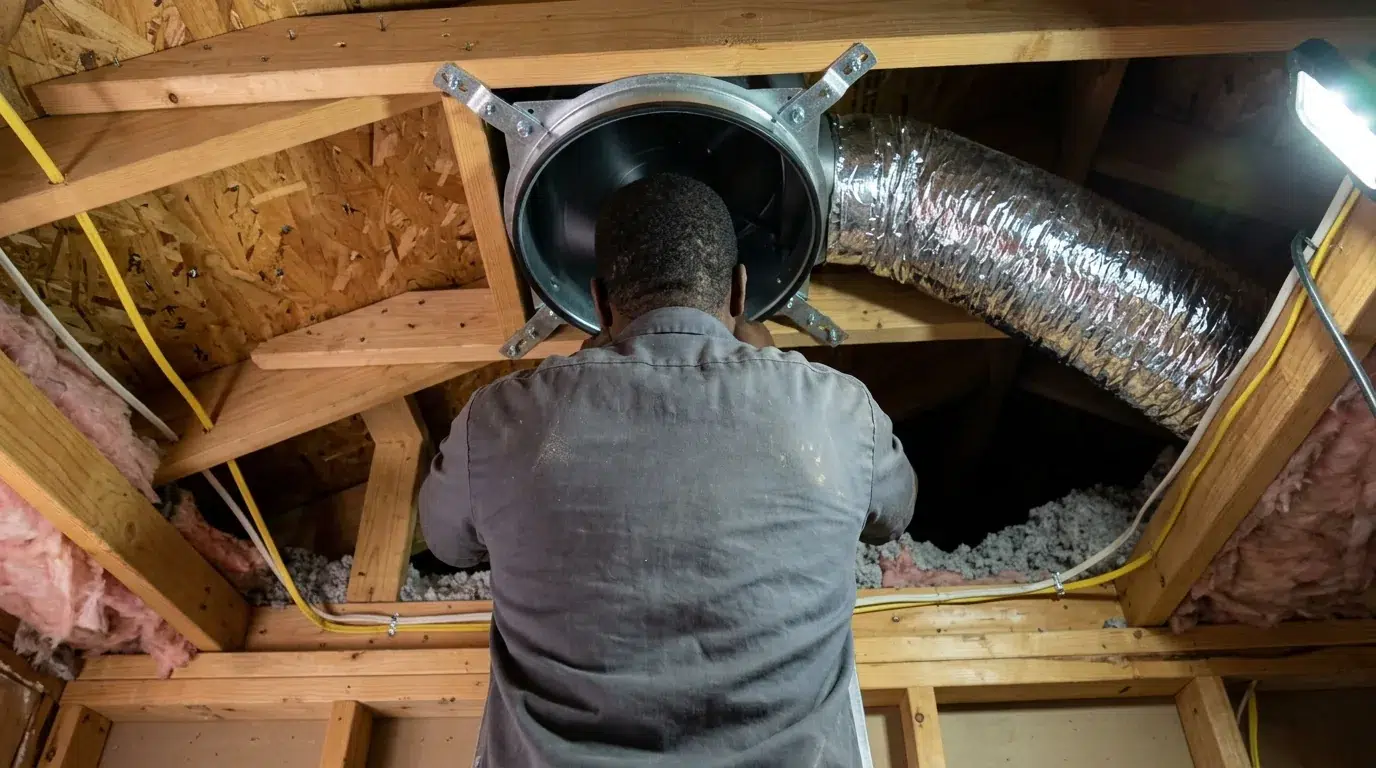
How the Fan Actually Cools the House
The fan sits in the ceiling, usually in a hallway, and exhausts house air into the attic, where it leaves through the attic vents. Open a couple of windows downstairs and cooler evening air is drawn through the house. The building is not being cooled by refrigeration; it is being flushed with outside air, which is why the system works beautifully at 9 p.m. in July and does nothing useful at 4 p.m.
That also explains the rule people get wrong: shut the windows and the fan has nowhere to pull air from. It depressurises the house, which in a tightly built home can pull air backwards down a gas water heater flue. Open enough windows before running the fan, and have combustion appliances assessed for backdraft risk before the fan is commissioned.
Attic Venting Decides Whether It Works
A fan rated at 3,000 CFM moves 3,000 cubic feet per minute only if the attic can exhaust that volume. The preliminary rule of thumb for attic relief is one square foot of net free vent area per 750 CFM, and net free area is not the same as the size of the vent opening — the manufacturer rates each vent, and that rating is what counts.
It is a guideline, not code, and the fan manufacturer’s instructions govern the installation. If the existing vents do not provide enough unobstructed net free area for the fan, attic pressure can reduce airflow and push attic air back through ceiling leaks. The answer may be additional attic relief venting suited to the roof and the fan manufacturer’s instructions, plus sealing ceiling penetrations — and it belongs in the quote rather than in a second visit.
New-Build Johnstown Homes: What’s Different
Most of Johnstown’s housing is recent, which changes two things. Tighter envelopes mean the depressurisation effect is stronger and the window discipline matters more. And modern attics are usually vented with a ridge-and-soffit combination sized for passive performance, with soffit vents that can be blocked by insulation the moment somebody adds a layer.
We check the existing vent area and inspect whether the soffit path is open before selecting a fan. A house that needs an extra intake vent is a house that needs it regardless of which brand goes in the ceiling.
Sizing, Noise and Controls
Sizing starts from the volume being flushed — conditioned square footage times ceiling height — and a range of air changes per hour that suits the household’s use. A 2,000-square-foot house with eight-foot ceilings is around 16,000 cubic feet; a fan moving 3,000 CFM turns that over in five or six minutes, which is the order of magnitude a whole house fan is designed for.
Noise is the specification people forget to ask about. Two fans with the same CFM rating can differ by ten decibels, which is the difference between a conversation and a shout — and the ducted, insulated units sit far quieter than the direct-drive boxes. Controls matter too: a two-speed wall switch, a timer so the fan cannot be left running into a cold house, and a humidistat where summer humidity is a real condition.
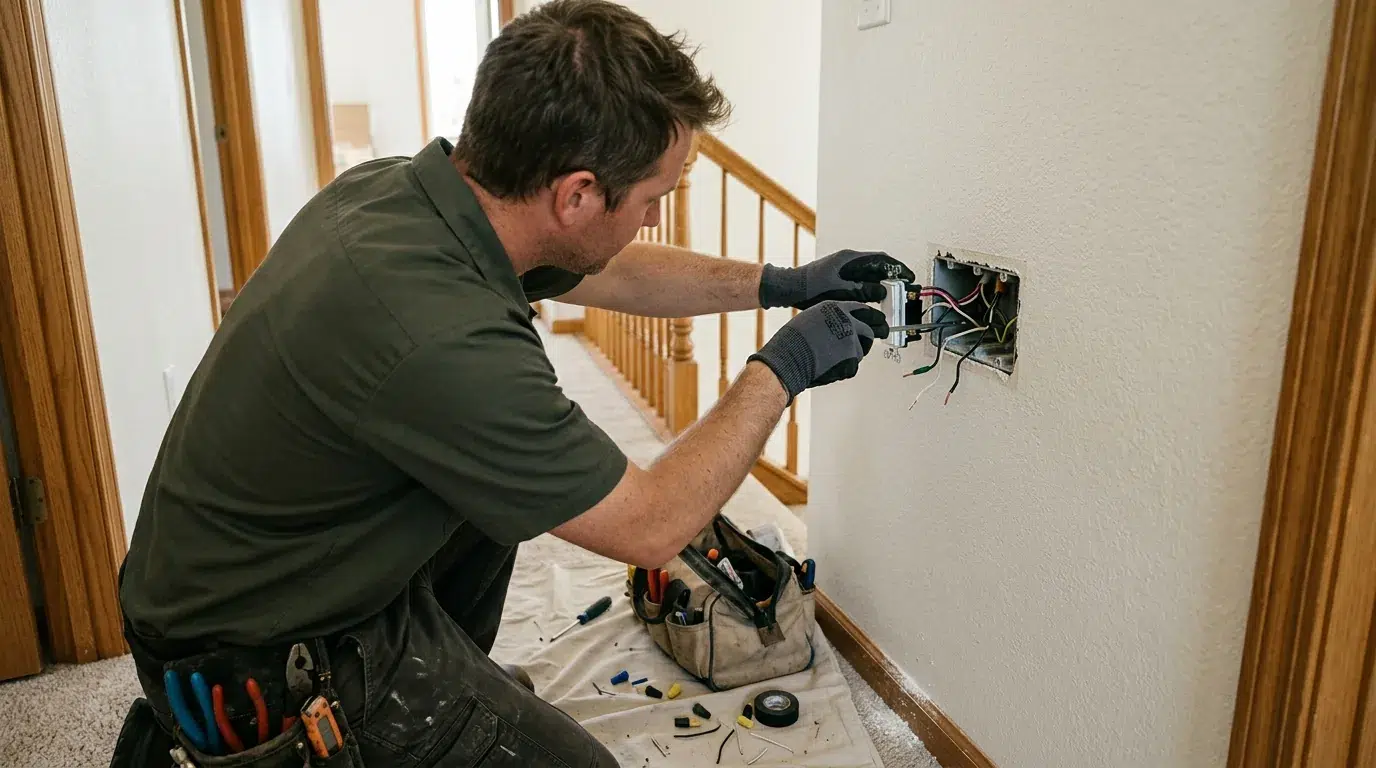
The Electrical Side
Most whole house fans need a dedicated circuit, and the size depends on the unit rather than on habit — a small direct-drive fan can run on a 15-amp circuit while a larger two-speed unit wants a 20-amp dedicated run. The fan also needs a service disconnect within sight where the code requires one, and the ceiling penetration has to be framed and finished.
If the panel is full, the circuit question becomes a panel question, which is why we look at the panel before quoting the fan.
Permits in Johnstown
The Town separates two cases that sound similar. Replacing a bathroom or ceiling fan with no wiring changes does not require a permit. Adding a circuit — which a new whole house fan normally does — is electrical work, and electrical work is on the Town’s permit-required list. Anything that alters the ceiling or the attic venting can also bring building review with it.
Permits run through the Town Building Department at 201 Centennial Drive, 970-587-4664, via the eTRAKiT portal, with plan review and inspection contracted to SafeBuilt, 970-305-3161. Inspection requests are due by 4:00 p.m. for the next business day, and contractors need a Town of Johnstown contractor licence. The 3.5% use tax on construction materials applies at permit issuance.
What Moves the Price
Fan model and CFM, whether the attic needs additional intake venting, the circuit and its distance from the panel, the control package, and ceiling access. A single-storey ranch with a walkable attic is the easy case; a vaulted ceiling with no attic access over the hall is where the labour goes.
We quote the fan, the venting work and the electrical as separate lines, because they are separate decisions and because the venting is the part that determines whether the money was well spent.
Related Work in Johnstown
The fan’s circuit starts at the panel — see panel replacement in Johnstown if the spaces are gone. If the same ceiling work includes new fixtures, lighting upgrades in Johnstown covers layout and dimming. For another town’s version of this job, read the Longmont whole house fan page, or start from our service area.


“Calvin and Cade install a porch fan and R&R a roof fan motor. They were professional, courteous, respectful, knowledgeable and expeditious examples for Precision Service Electric.”
Frequently Asked Questions
Do I need a permit for a whole house fan in Johnstown?
Usually yes, because the fan needs a new circuit and electrical work is on the Town’s permit list. Johnstown exempts a ceiling-fan replacement with no wiring changes; for a whole house fan and any ceiling or venting work, we confirm the permit requirements with the Town.
Does a whole house fan replace air conditioning?
No. It replaces the evening and overnight cooling, and it does nothing for a 95-degree afternoon. Most Colorado households that install one run the air conditioning less, not never.
Why do the windows have to be open?
The fan exhausts air into the attic and out the vents; without an open window the house depressurises and the fan has nothing to move. Open windows also reduce the depressurisation that can pull flue gases backwards in a tight house, though they do not guarantee a safe draft on their own.
My attic only has a ridge vent — is that enough?
Often not for a whole house fan. The fan needs enough open windows to admit air to the house and enough attic relief area to let it escape; the preliminary guideline is one square foot of net free attic vent area per 750 CFM, measured by the vent’s rated net free area rather than its opening size.
How loud is it?
That depends entirely on the unit. Two fans with identical CFM ratings can differ by around ten decibels, and ducted insulated units are markedly quieter than direct-drive boxes. It is worth choosing on sound, not only on airflow.
Will it work in a two-storey house?
Yes, with attention to where the air enters. The fan pulls from whichever windows are open, so the useful pattern is downstairs windows open and upstairs doors open, letting the air travel through the house rather than straight up the stairwell.
Request a Whole House Fan Quote in Johnstown
A photo of the attic from the access hatch and one of the open panel tells us most of what we need. Precision Service Electric is family owned, in business 30 years, licensed and insured under Colorado license #3918, factory-trained and an authorized Generac dealer, and rated 4.8 stars across 47 Google reviews. Call 970-593-3190 or request a quote.