

A standby generator is a small power plant bolted to the side of a house, and in Longmont it comes with a set of local conditions that most quotes ignore: a municipal electric utility with its own rate structure, a city contractor licence that does not accept another jurisdiction’s, and a permit process that runs through a portal rather than a counter. Precision Service Electric installs Generac standby systems in Longmont and works through all three before anyone orders equipment. Call 970-593-3190.
Why Longmont Homes Lose Power
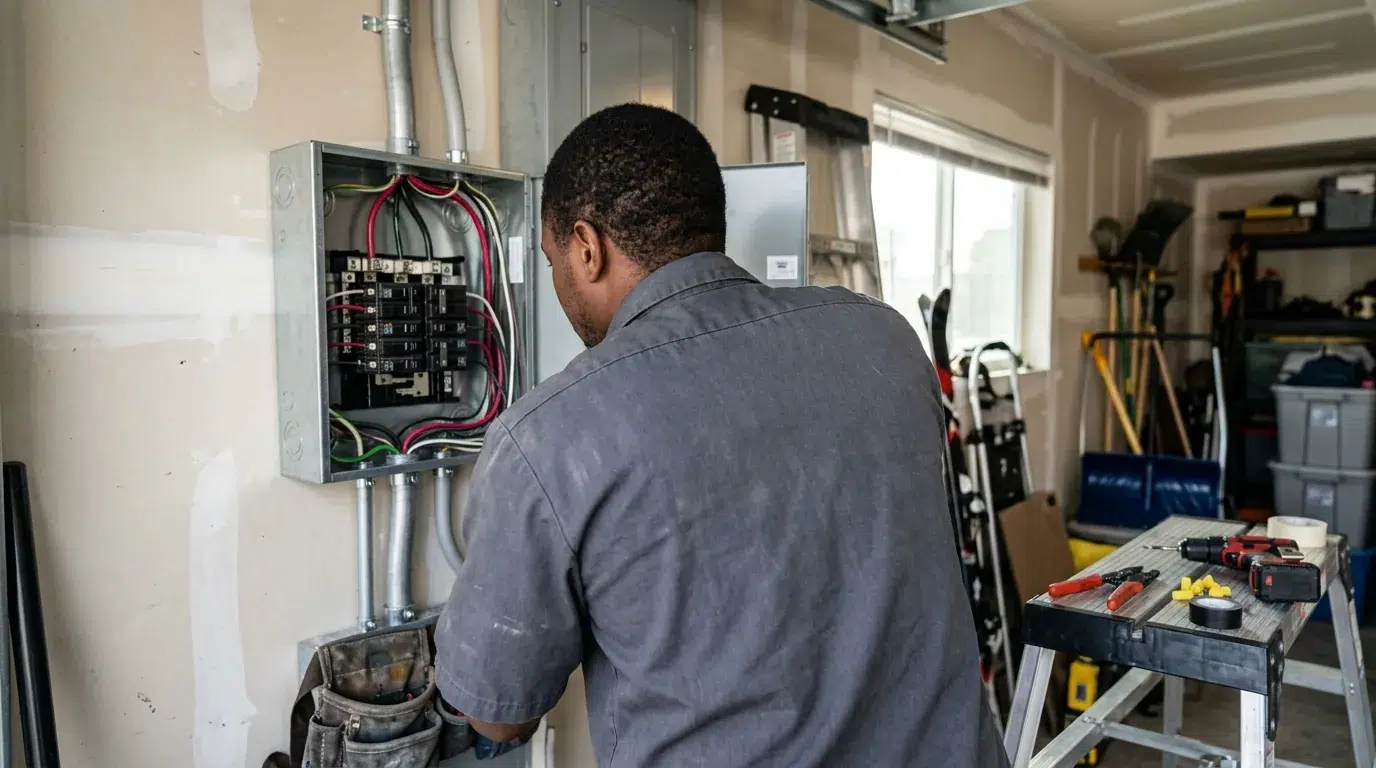
Longmont’s outages are mostly weather-driven: the spring and summer storms that roll off the Front Range bring wind that takes limbs down across overhead distribution, and winter storms do the same with snow load and ice. Longmont Power & Communications maintains its own distribution system, which is one reason the utility publishes outage reporting separately from the surrounding Xcel territory.
The other reason a household buys a generator is not the storm at all — it is the sump pump, the furnace, the refrigerator, the medical equipment, or a home office that cannot go dark during a scheduled repair.
Standby vs Portable: What a Standby System Actually Does
A standby generator sits outside, runs on natural gas or propane, and starts automatically when utility power fails. Within seconds the automatic transfer switch disconnects the house from the grid and connects it to the generator. When utility power returns, the switch transfers back and the generator shuts down and cools.
A portable generator does none of that: someone has to wheel it out, start it, run cords, and manage fuel. It is a legitimate tool for a job site or a short outage, and a poor substitute for a system that has to protect a house while nobody is home.
The Transfer Switch Decides What Stays On
Whole-Home Transfer
A service-rated automatic transfer switch carries the entire panel. Everything in the house works during an outage, subject to the generator’s capacity. This is the arrangement most homeowners picture, and it is the one that requires the generator to be sized for the whole service load.
Essential-Circuits Transfer
A separate arrangement — an essential-circuits switch — carries only a chosen set of loads: furnace, refrigerator, well pump, some lighting. That is not the same thing as whole-home backup with automatic load shedding, and it costs less. Under the code the generator has to be sized for the maximum load the transfer equipment can connect, whichever arrangement is chosen.
Where the generator install uncovers a panel that cannot carry the new transfer equipment, the two jobs merge into one scope: the panel work is described in the panel replacement guide, and the same sequence applies here.
Automatic Load Management
Load-management modules let a smaller generator serve a larger panel by shedding specific loads — the air conditioner, the electric range, the EV charger — while they are running. It is a real engineering solution, not a trick, and it has to be designed rather than assumed.
Fuel: Natural Gas or Propane
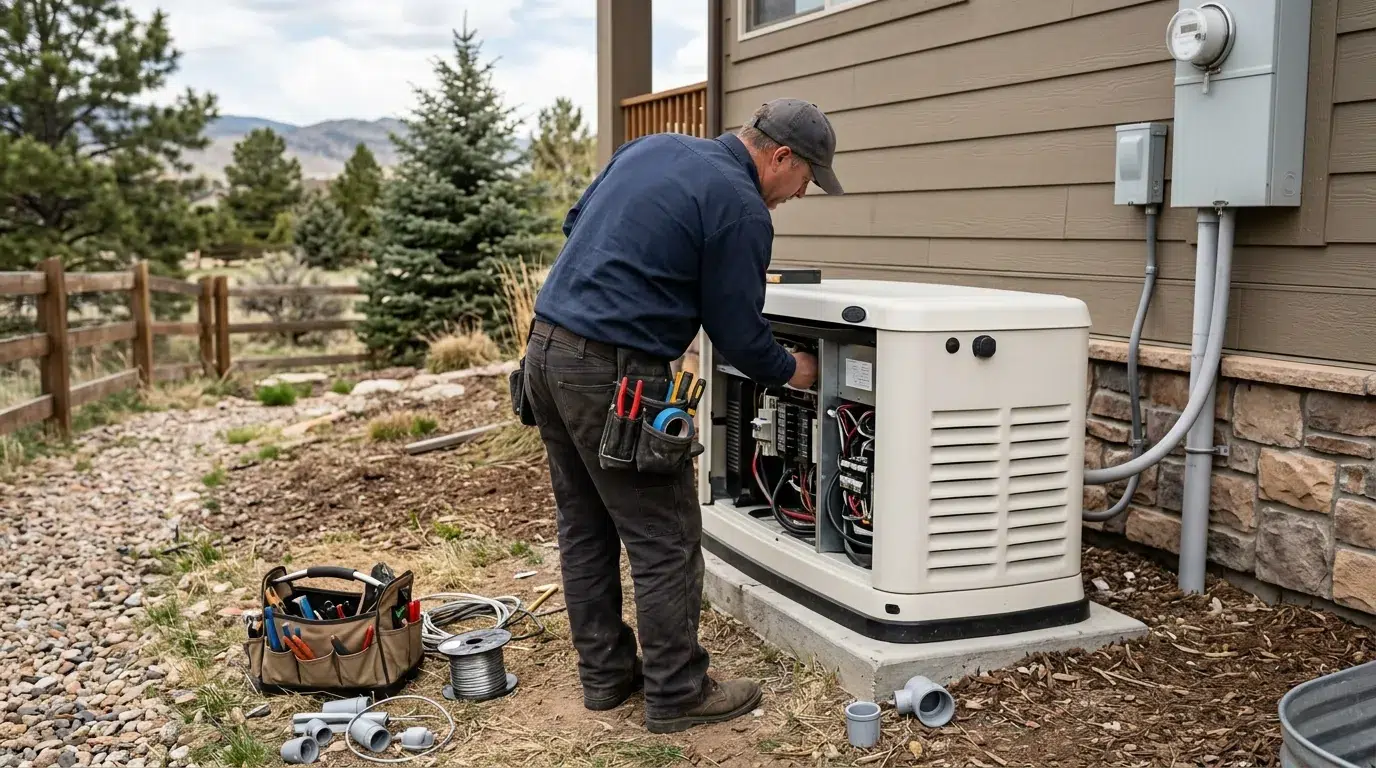
Natural gas in Longmont comes from Xcel Energy. A natural-gas unit needs no tank and no deliveries, and it runs as long as the gas main is pressurised — which, in a widespread outage, is usually the case, but not guaranteed.
Propane requires a tank sized for the run time you want, a delivery contract, and a regulator at the generator. It costs more to set up and is the right answer where the gas main is unavailable or where the household wants independence from the gas distribution system.
The fuel decision also sets the generator’s output: the same model is rated differently on natural gas and on propane, and the sizing calculation has to use the fuel actually installed.
Sizing: The Calculation That Cannot Be Skipped
Sizing starts from the load the transfer equipment can connect, then adds motor-starting allowances for the air conditioner, furnace blower, well pump and refrigerator compressors. A house with a 200-amp service and electric everything needs a larger unit than the same square footage with gas heat and a gas range.
The common failure in this market is a generator sold from a square-footage chart. The other common failure is a unit sized to the panel rather than to the load — a 22 kW generator behind a 200-amp service that only ever draws 12 kW is money spent on capacity nobody uses.
Longmont’s Own Utility Picture
Longmont is one of the Colorado cities with its own municipal electric utility: Longmont Power & Communications has supplied the city since 1912, with a main office at 1100 S Sherman Street and outage reporting on 303-651-8386 or 303-776-0011.
Its residential rate is tiered by usage. Tier 1 covers up to 750 kWh at 10.57¢ per kWh non-summer and 11.64¢ summer; Tier 2 covers 751 to 1,500 kWh at 12.45¢ and 13.73¢; Tier 3 covers 1,501 kWh and above at 16.18¢ and 17.83¢, with a $17.50 monthly customer charge. An optional residential demand rate also exists.
That structure matters in one specific way for generator buyers: the tiers are where an added large load shows up. Running a standby generator does not change your utility rate, but adding a heat pump or an EV charger alongside it does move consumption into higher tiers — and the load calculation for the generator should be done with that future in mind, not just with today’s appliances.
Permits, Licensing and Inspection in Longmont
Permits run through City of Longmont Building Services at the Development Services Center, 385 Kimbark Street, Longmont CO 80501 — 303-651-8332. Applications and inspections go through the Accela Citizen Access portal; inspection requests must be in by 4:00 p.m. the business day before.
The licensing point is the one worth checking on any quote. The City requires a valid Longmont contractor licence under Municipal Code 16.48.030, states plainly that it does not offer reciprocal licensing with other jurisdictions, and requires electricians to submit a current Colorado master licence and contractor licence. A contractor licensed in a neighbouring city is not licensed here by default.
The electrical scope is permitted and inspected by Building Services — the transfer switch and the generator circuit — and the gas connection is inspected as part of the same project. Where the installation touches the utility’s system, Longmont Power & Communications’ interconnection requirements apply, and we confirm the utility’s requirement for the specific installation before the work is scheduled. The final inspection looks at the installation, the labelling, the clearances from the structure and the transfer operation.
What a Standby System Costs
The only published figure worth quoting in this region is a contractor’s: MSI Mechanical, a Northern Colorado company, lists total installed cost for residential standby systems at $7,500 to $18,000+. Equipment-only prices that circulate online describe the box, not the installation — the base, the gas line, the transfer switch, the permits and the labour are the rest of the number, and none of it is a Precision Service Electric quote.
What moves a specific house within that range: generator size, transfer-switch type, fuel, distance from the gas meter and the panel, whether a concrete pad or a manufacturer-approved base is used, and permit fees.
Maintenance After the Install
A standby generator is a combustion engine that sits idle for months. It needs an exercise cycle (most controllers run one weekly), oil and filter service on an interval, battery replacement every few years, and an annual inspection of the gas connection and the transfer operation. A generator that has not been exercised is a generator that may not start.
Related Work
Generac equipment and service is covered on the Generac page. The same scope in neighbouring cities is on the Loveland generator page, the Fort Collins generator page and the Windsor generator page and the Greeley generator page; our service area covers the rest of Northern Colorado.
Frequently Asked Questions
Do I need a permit for a standby generator in Longmont?
Yes. The electrical work is permitted through City of Longmont Building Services and inspected, and the gas connection is part of the same project. Applications and inspections run through the Accela portal.
How big a generator does my house need?
It depends on what the transfer switch can connect and on the motor-starting loads, not on square footage. A gas-heated house with a gas range needs less than the same house with electric heat and an EV charger.
Can a standby generator run my air conditioner?
Only if it is sized for the starting current, or if load management is installed to shed the compressor while other loads run. This is a design decision made before the unit is ordered.
Will the generator run on natural gas in Longmont?
Natural gas in Longmont is supplied by Xcel Energy, so a natural-gas unit needs no tank. Propane is the alternative where gas service is unavailable or where independence from the gas main is preferred.
How long does installation take?
The mechanical work is usually a day or two once the equipment and the permit are in hand; the elapsed time is driven by permit review, equipment lead time and the gas connection. The quote states the sequence rather than a single number.
Does a generator add value to a Longmont home?
It is a resilience feature rather than a cosmetic upgrade, and buyers in this market treat a permitted, inspected installation differently from an unpermitted one. The permit history is checkable at resale.


“Technician was very knowledgeable and fixed several problems I was having with my electrical problems.”
Request a Generator Quote in Longmont
Send a photo of the meter, the panel and the proposed generator location, and the sizing conversation starts with the facts on the wall. Precision Service Electric is family owned, in business 30 years, licensed and insured under Colorado license #3918, factory-trained and an authorised Generac dealer, and rated 4.8 stars across 47 Google reviews. Call 970-593-3190 or request a quote.